
What topics and trends defined most-cited Anesthesia and Pain Management research in the Class of 2026?
Ultrasound-guided nerve block, morphine milligram equivalents, and propofol define the Class of 2026 anesthesia cohort, alongside a focus on precise outcome measurement. Ultrasound-guided blocks and standardized opioid metrics rose sharply from the Class of 2025, while opioid-free anesthesia and esketamine receded among top-cited papers.
At a glance
- Field
- Anesthesia and Pain Management
- Cohort label
- Class of 2026 (2024 publications)
- Papers analyzed
- 9,015
- Papers ranked
- 20
- Top topics in ranked papers
- Ultrasound-guided nerve block, morphine milligram equivalents, numeric rating scale, propofol
- Publication window
- Jan 1, 2024 – Dec 31, 2024
- Eligibility
- Research articles; reviews excluded
- Citation window
- 18 months post-publication
- 18m citation range
- 18–38
- Data source
- OpenAlex · Retrieved Jul 2026
- License
- CC BY 4.0
Rankings
20 papers ranked by 18-month citation count
Anaesthetic efficacy and postinduction hypotension with remimazolam compared with propofol: a multicentre randomised controlled trial
Anaesthesia202410.1111/anae.16205
Complication Rates After Ultrasonography-Guided Nerve Blocks Performed in the Emergency Department
JAMA Network Open202410.1001/jamanetworkopen.2024.44742
Perioperative Adjunctive Esketamine for Postpartum Depression Among Women Undergoing Elective Cesarean Delivery
JAMA Network Open202410.1001/jamanetworkopen.2024.0953
Serratus Anterior Plane Blocks for Early Rib Fracture Pain Management
JAMA Surgery202410.1001/jamasurg.2024.0969
Injectable Hydrogel Delivery System with High Drug Loading for Prolonging Local Anesthesia
Advanced Science202410.1002/advs.202309482
Chronic postsurgical pain
European Journal of Anaesthesiology202410.1097/eja.0000000000001974
Trends in Opioid Prescribing and New Persistent Opioid Use After Surgery in the United States
Annals of Surgery202410.1097/sla.0000000000006461
Comparison of opioid‐free and opioid‐inclusive propofol anaesthesia for thyroid and parathyroid surgery: a randomised controlled trial
Anaesthesia202410.1111/anae.16382
Intravenous Lidocaine for Gut Function Recovery in Colonic Surgery
JAMA202410.1001/jama.2024.23898
Glucagon-like peptide-1 receptor agonist use is associated with increased risk of perioperative complication and readmission following shoulder arthroplasty
Journal of Shoulder and Elbow Surgery202410.1016/j.jse.2024.09.012
Cardiac arrest in obstetric patients receiving anaesthetic care: results from the 7th National Audit Project of the Royal College of Anaesthetists
Anaesthesia202410.1111/anae.16204
EXPERIENCE OF THE ULTRASOUND-ASSISTED NERVE BLOCKADE OF THE FASCIAL PLANE BY ERECTOR SPINE BLOCK IN ACUTE PANCREATITIS
Unknown Journal202410.34660/inf.2023.35.17.077
Addition of Liposomal Bupivacaine to Standard Bupivacaine versus Standard Bupivacaine Alone in the Supraclavicular Brachial Plexus Block: A Randomized Controlled Trial
Anesthesiology202410.1097/aln.0000000000005035
Comparison of remimazolam-based and propofol-based total intravenous anesthesia on hemodynamics during anesthesia induction in patients undergoing transcatheter aortic valve replacement: a randomized controlled trial
Journal of Anesthesia202410.1007/s00540-024-03311-x
Unilateral sacral erector spinae plane block for hip fracture surgery
Anaesthesia Reports202410.1002/anr3.12269
An Engineered Bionic Nanoparticle Sponge as a Cytokine Trap and Reactive Oxygen Species Scavenger to Relieve Disc Degeneration and Discogenic Pain
ACS Nano202410.1021/acsnano.3c08097
Effectiveness of the Bilateral and Bilevel Erector Spinae Plane Block (ESPB) in Pediatric Idiopathic Scoliosis Surgery: A Randomized, Double-Blinded, Controlled Trial
Journal of Pediatric Orthopaedics202410.1097/bpo.0000000000002707
Effect of remimazolam versus propofol on hypotension after anesthetic induction in patients undergoing coronary artery bypass grafting: A randomized controlled trial
Journal of Clinical Anesthesia202410.1016/j.jclinane.2024.111580
Lower socioeconomic status is correlated with worse outcomes after arthroscopic rotator cuff repair
Journal of Orthopaedic Surgery and Research202410.1186/s13018-024-05360-0
Does use of glucagon-like peptide-1 agonists increase perioperative complications in patients undergoing shoulder arthroplasty?
Journal of Shoulder and Elbow Surgery202410.1016/j.jse.2024.07.045
Topic trends
Dominant research themes and year-over-year shifts in Anesthesia and Pain Management
What Topics Define the Class of 2026?
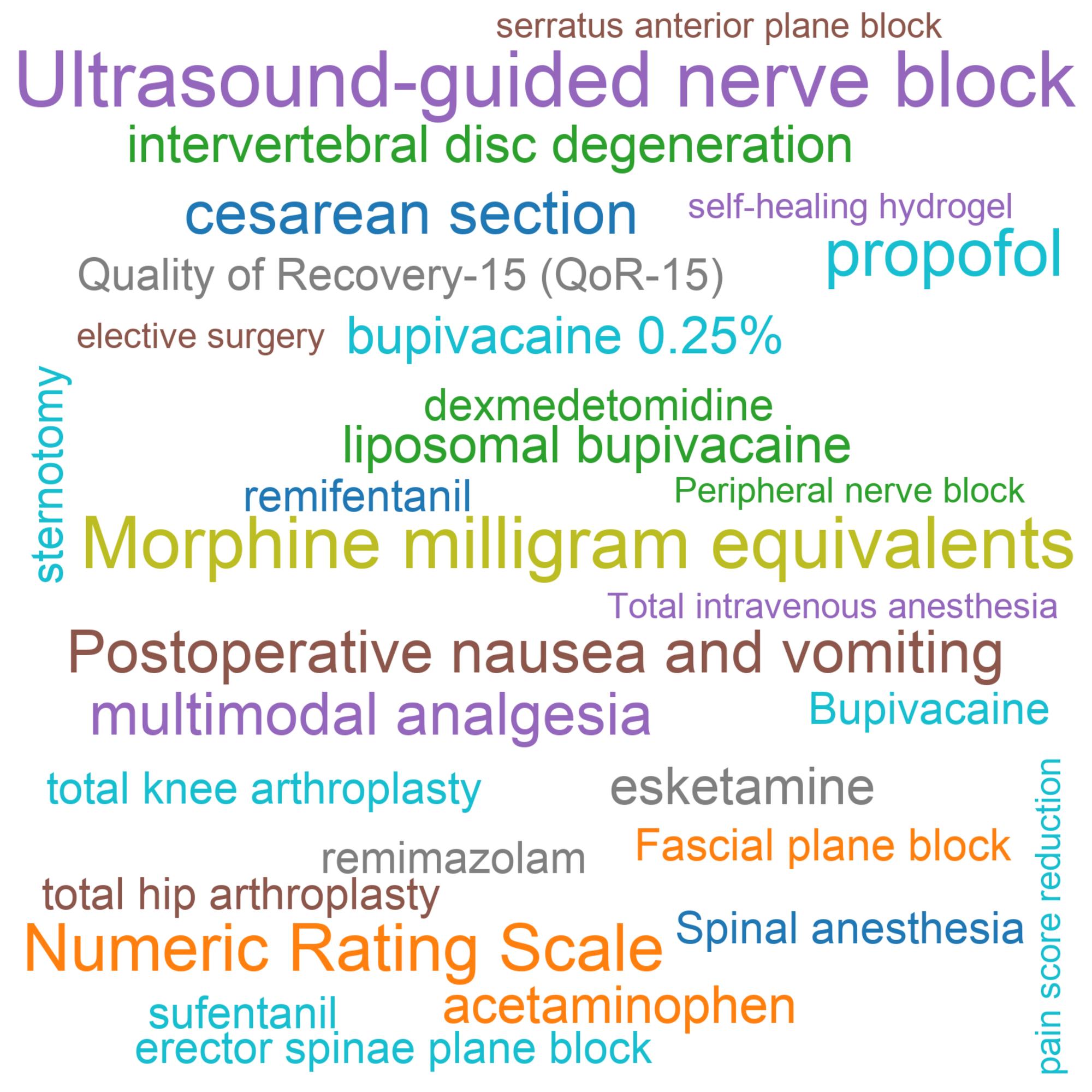
The informative word cloud across the highest 18-month-cited anesthesia and pain management papers reveals a field emphasizing regional techniques, precision outcome metrics, and targeted anesthetics. Ultrasound-guided nerve block leads the cohort (normalized frequency 0.16), underscoring the central role of image-guided interventions in impactful 2024 literature. Morphine milligram equivalents follows closely (0.14), highlighting a rigorous focus on standardized opioid measurement. A robust tier of clinical endpoints and agents includes the Numeric Rating Scale (0.12) and propofol (0.12), alongside Postoperative nausea and vomiting (0.10), cesarean section (0.10), and multimodal analgesia (0.10). Advanced pain management modalities also surface prominently, with acetaminophen, bupivacaine 0.25%, esketamine, intervertebral disc degeneration, and liposomal bupivacaine each appearing at a normalized frequency of 0.08. After informativeness filtering, broad labels are excluded, leaving a precise portrait of a specialty that prioritizes ultrasound-guided regional techniques, standardized pain and opioid metrics, and targeted pharmacological agents in the highest-impact 2024 publications.
How Did Topics Shift from the Class of 2025 to the Class of 2026?
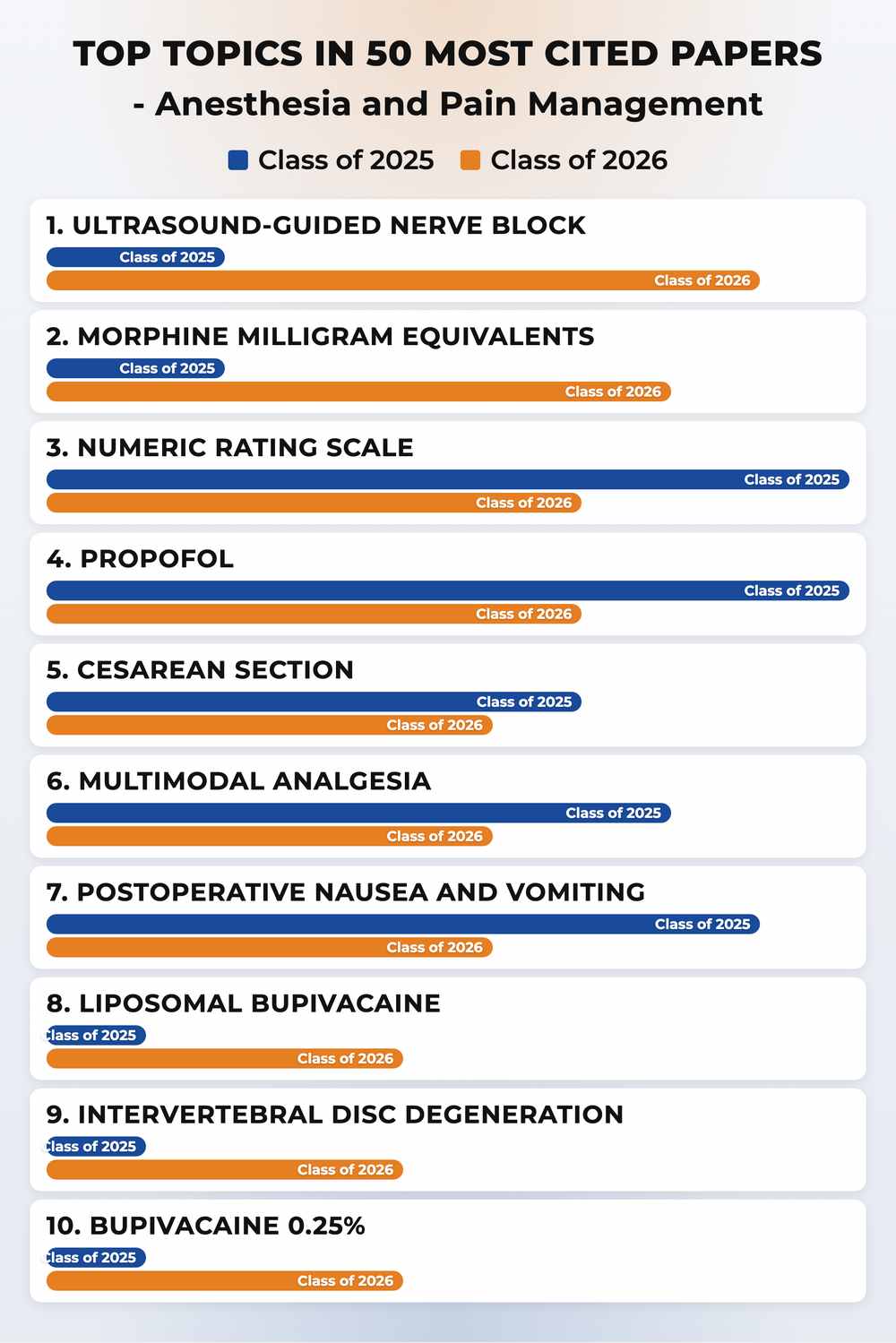
Comparing normalized concept frequencies between the Class of 2025 (2023 publications) and Class of 2026 (2024 publications) cohorts reveals a reorientation of early-high-impact anesthesia research toward ultrasound-guided techniques and standardized opioid metrics. Ultrasound-guided nerve block exhibited the largest gain (+0.12 normalized frequency), followed by morphine milligram equivalents (+0.10), liposomal bupivacaine (+0.08), bupivacaine 0.25% (+0.06), and intervertebral disc degeneration (+0.06). The topic evolution card highlights these shifts, showing Class of 2026 bars extending furthest for these precise interventions and outcome measures. Conversely, opioid-free anesthesia showed the steepest decline (−0.12), reflecting reduced dominance of this specific paradigm among the most-cited papers. Esketamine (−0.08) also receded, alongside the Numeric Rating Scale (−0.06), propofol (−0.06), and Postoperative nausea and vomiting (−0.06). Together, these shifts suggest that the most-cited 2024 papers increasingly emphasize specific ultrasound-guided regional techniques and advanced local anesthetic formulations over broader pharmacological concepts like esketamine or overarching narratives like opioid-free anesthesia.
Methodology
PRI identifies high-impact research using a transparent, topic-agnostic framework applied consistently across scientific domains. Bibliographic records are drawn from OpenAlex, including publication dates, citation relationships, and document types.
This ranking covers the Class of 2026 cohort: journal articles published in 2024. Reviews and other non-article document types are excluded to ensure comparability.
Research impact is quantified with an 18-month post-publication citation window—the number of citing works published within 18 months of each paper's publication date. This metric captures early impact while controlling for publication age.
An LLM-based relevance classifier then reviews each candidate's title and abstract to confirm substantive alignment with the target domain. Only papers classified as relevant appear in the final ranking.
Zheng Su, Tinsley Li, Thematic Shifts in Early-High-Impact Cancer Genomics and Diagnostics Research: A Bibliometric and Semantic Analysis. bioRxiv 2026.07.04.736459; doi: https://doi.org/10.64898/2026.07.04.736459
Cite this ranking
Pepkio Research Index (PRI). Topics and Trends in Most Cited Anesthesia and Pain Management Papers, Class of 2026. https://pri.pepkio.com/top-papers/anesthesia-and-pain-management/2026. Accessed 2026-10-14.

Methodology
Zheng Su, Tinsley Li, Thematic Shifts in Early-High-Impact Cancer Genomics and Diagnostics Research: A Bibliometric and Semantic Analysis. bioRxiv 2026.07.04.736459; doi: https://doi.org/10.64898/2026.07.04.736459