
What topics and trends defined most-cited Dialysis and Renal Disease Management research in the Class of 2026?
Cardiometabolic multimorbidity, CKM syndrome, and cellular mechanisms like tubular epithelial cells define the Class of 2026 dialysis and renal disease cohort. Type 2 diabetes and cardio-renal-metabolic multimorbidity rose sharply from the Class of 2025, while serum cystatin C receded among top-cited papers.
At a glance
- Field
- Dialysis and Renal Disease Management
- Cohort label
- Class of 2026 (2024 publications)
- Papers analyzed
- 7,336
- Papers ranked
- 20
- Top topics in ranked papers
- Renal fibrosis, Cardiovascular disease, Diabetic kidney disease, Tubular epithelial cells
- Publication window
- Jan 1, 2024 – Dec 31, 2024
- Eligibility
- Research articles; reviews excluded
- Citation window
- 18 months post-publication
- 18m citation range
- 34–1,725
- Data source
- OpenAlex · Retrieved Jul 2026
- License
- CC BY 4.0
Rankings
20 papers ranked by 18-month citation count
A Study to Evaluate Psychological Distress and Self-Esteem Among Patients with Hemodialysis
International Journal of Innovative Science and Research Technology (IJISRT)202410.38124/ijisrt/ijisrt24mar1998
A Randomized Trial of Intravenous Amino Acids for Kidney Protection
New England Journal of Medicine202410.1056/nejmoa2403769
Association between different stages of cardiovascular-kidney-metabolic syndrome and the risk of all-cause mortality
Atherosclerosis202410.1016/j.atherosclerosis.2024.118585
The glycolytic enzyme PFKFB3 drives kidney fibrosis through promoting histone lactylation-mediated NF-κB family activation
Kidney International202410.1016/j.kint.2024.04.016
Social Risk Profile and Cardiovascular‐Kidney‐Metabolic Syndrome in US Adults
Journal of the American Heart Association202410.1161/jaha.124.034996
Finerenone and Kidney Outcomes in Patients With Heart Failure
Journal of the American College of Cardiology202410.1016/j.jacc.2024.10.091
IL-6 inhibition with clazakizumab in patients receiving maintenance dialysis: a randomized phase 2b trial
Nature Medicine202410.1038/s41591-024-03043-1
Projecting the economic burden of chronic kidney disease at the patient level (Inside CKD): a microsimulation modelling study
EClinicalMedicine202410.1016/j.eclinm.2024.102615
Lifestyle factors and their relative contributions to longitudinal progression of cardio-renal-metabolic multimorbidity: a prospective cohort study
Cardiovascular Diabetology202410.1186/s12933-024-02347-3
Association of systemic immune-inflammation index and systemic inflammation response index with chronic kidney disease: observational study of 40,937 adults
Inflammation Research202410.1007/s00011-024-01861-0
Mitochondrial oxidative damage reprograms lipid metabolism of renal tubular epithelial cells in the diabetic kidney
Cellular and Molecular Life Sciences202410.1007/s00018-023-05078-y
Association of cardiovascular-kidney-metabolic health and social connection with the risk of depression and anxiety
Psychological Medicine202410.1017/s0033291724002381
Epidemiological shifts in chronic kidney disease: a 30-year global and regional assessment
BMC Public Health202410.1186/s12889-024-21065-9
Aldehyde Dehydrogenase 2 Lactylation Aggravates Mitochondrial Dysfunction by Disrupting PHB2 Mediated Mitophagy in Acute Kidney Injury
Advanced Science202410.1002/advs.202411943
Comparative analysis of gut microbiota in incident and prevalent peritoneal dialysis patients with peritoneal fibrosis, correlations with <scp>peritoneal equilibration test</scp> data in the peritoneal fibrosis cohort
Therapeutic Apheresis and Dialysis202410.1111/1744-9987.14226
Association between neutrophil-to-lymphocyte ratio and diabetic kidney disease in type 2 diabetes mellitus patients: a cross-sectional study
Frontiers in Endocrinology202410.3389/fendo.2023.1285509
Predicting the risks of kidney failure and death in adults with moderate to severe chronic kidney disease: multinational, longitudinal, population based, cohort study
BMJ202410.1136/bmj-2023-078063
Social support, family resilience and psychological resilience among maintenance hemodialysis patients: a longitudinal study
BMC Psychiatry202410.1186/s12888-024-05526-4
Autophagy-deficient macrophages exacerbate cisplatin-induced mitochondrial dysfunction and kidney injury via miR-195a-5p-SIRT3 axis
Nature Communications202410.1038/s41467-024-47842-z
The CONVINCE randomized trial found positive effects on quality of life for patients with chronic kidney disease treated with hemodiafiltration
Kidney International202410.1016/j.kint.2024.07.014
Topic trends
Dominant research themes and year-over-year shifts in Dialysis and Renal Disease Management
What Topics Define the Class of 2026?
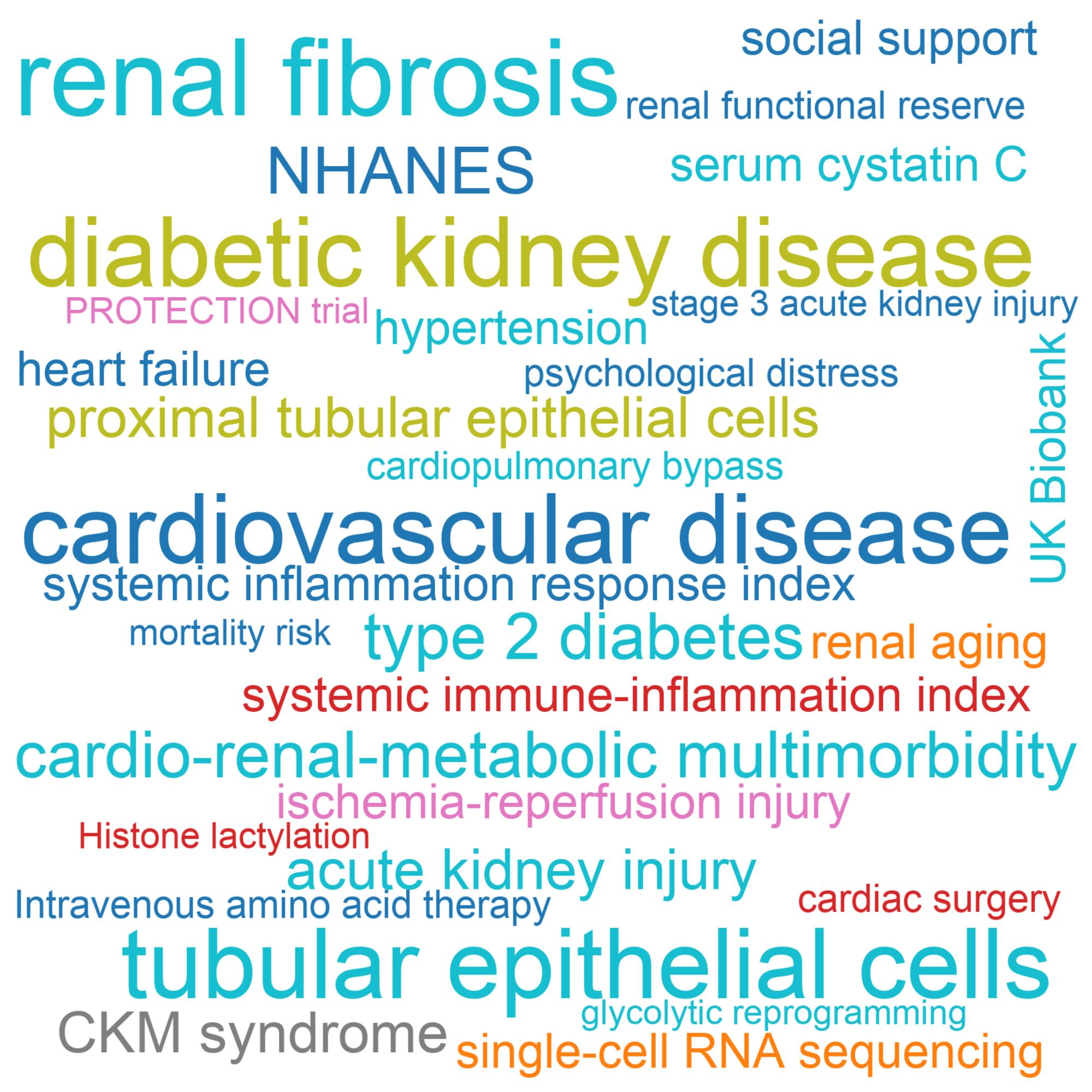
The informative word cloud across the 50 highest 18-month-cited dialysis and renal disease management papers reveals a field centered on kidney pathophysiology, cardiometabolic comorbidity, and cellular mechanisms—not generic dialysis terminology. Renal fibrosis leads at 7 of 50 papers (normalized frequency 0.14), alongside cardiovascular disease (6 papers, 0.12) and diabetic kidney disease (6 papers, 0.12). This cluster is complemented by a strong cellular focus, with tubular epithelial cells appearing in 6 papers (0.12). Cardiometabolic overlap is further evidenced by type 2 diabetes and cardio-renal-metabolic multimorbidity (both 5 papers, 0.10), as well as NHANES epidemiology (5 papers, 0.10). Other mid-sized terms emphasize acute kidney injury (4 papers, 0.08), CKM syndrome (4 papers, 0.08), and proximal tubular epithelial cells (4 papers, 0.08). After informativeness filtering, broad labels such as chronic kidney disease and end-stage kidney disease are excluded, highlighting specific fibrotic mechanisms, cardiometabolic phenotypes, and cellular drivers over umbrella disease names.
How Did Topics Shift from the Class of 2025 to the Class of 2026?
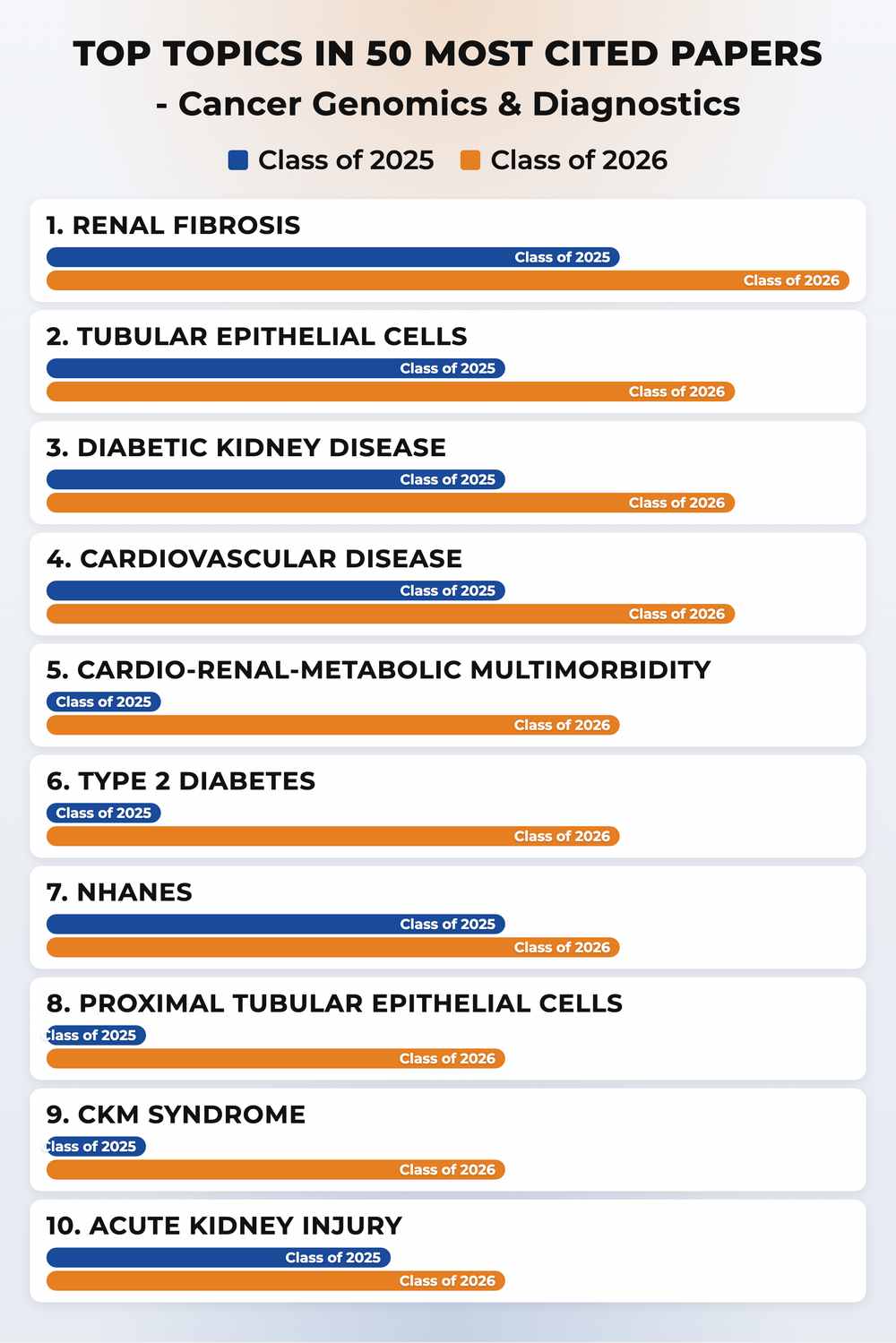
Comparing normalized concept frequencies between the Class of 2025 (2023 publications) and Class of 2026 (2024 publications) cohorts shows a reorientation of early-high-impact research toward cardiometabolic multimorbidity and specific cellular mechanisms. Cardio-renal-metabolic multimorbidity and type 2 diabetes exhibited the largest gains among informative concepts (both +0.08 normalized frequency; 1 versus 5 papers), closely followed by emerging topics absent from the 2023 top cohort: CKM syndrome and proximal tubular epithelial cells (both +0.08; 0 versus 4 papers). The topic evolution card underscores that Class of 2026 bars also extend further for renal aging, UK Biobank, and systemic inflammation indices (all +0.06; 0 versus 3 papers). Core pathologies like renal fibrosis, cardiovascular disease, and diabetic kidney disease also saw modest increases (+0.04). Conversely, serum cystatin C showed a steep decline (−0.08; 7 versus 3 papers), and heart failure declined slightly (−0.02; 4 versus 3 papers). Together, these shifts suggest that the most-cited 2024 papers increasingly emphasize broad cardiometabolic intersections, inflammatory phenotyping, and tubular cellular responses.
Methodology
PRI identifies high-impact research using a transparent, topic-agnostic framework applied consistently across scientific domains. Bibliographic records are drawn from OpenAlex, including publication dates, citation relationships, and document types.
This ranking covers the Class of 2026 cohort: journal articles published in 2024. Reviews and other non-article document types are excluded to ensure comparability.
Research impact is quantified with an 18-month post-publication citation window—the number of citing works published within 18 months of each paper's publication date. This metric captures early impact while controlling for publication age.
An LLM-based relevance classifier then reviews each candidate's title and abstract to confirm substantive alignment with the target domain. Only papers classified as relevant appear in the final ranking.
Zheng Su, Tinsley Li, Thematic Shifts in Early-High-Impact Cancer Genomics and Diagnostics Research: A Bibliometric and Semantic Analysis. bioRxiv 2026.07.04.736459; doi: https://doi.org/10.64898/2026.07.04.736459
Cite this ranking
Pepkio Research Index (PRI). Topics and Trends in Most Cited Dialysis and Renal Disease Management Papers, Class of 2026. https://pri.pepkio.com/top-papers/dialysis-and-renal-disease-management/2026. Accessed 2026-10-14.

Methodology
Zheng Su, Tinsley Li, Thematic Shifts in Early-High-Impact Cancer Genomics and Diagnostics Research: A Bibliometric and Semantic Analysis. bioRxiv 2026.07.04.736459; doi: https://doi.org/10.64898/2026.07.04.736459