
What topics and trends defined most-cited Atrial Fibrillation Management and Outcomes research in the Class of 2026?
Pulsed field ablation, catheter ablation, pulmonary vein isolation, and CHA2DS2-VASc scoring anchor the Class of 2026 atrial fibrillation cohort. Pulsed field ablation, anticoagulation therapy, and new-onset atrial fibrillation themes rose sharply from Class of 2025, while pulmonary vein isolation, paroxysmal AF, and arrhythmia recurrence receded among top-cited work.
At a glance
- Field
- Atrial Fibrillation Management and Outcomes
- Cohort label
- Class of 2026 (2024 publications)
- Papers analyzed
- 10,306
- Papers ranked
- 20
- Top topics in ranked papers
- Pulsed field ablation, Catheter ablation, Pulmonary vein isolation, CHA2DS2-VASc score, Radiofrequency ablation
- Publication window
- Jan 1, 2024 – Dec 31, 2024
- Eligibility
- Research articles; reviews excluded
- Citation window
- 18 months post-publication
- 18m citation range
- 46–278
- Data source
- OpenAlex · Retrieved Jul 2026
- License
- CC BY 4.0
Rankings
20 papers ranked by 18-month citation count
Safety of pulsed field ablation in more than 17,000 patients with atrial fibrillation in the MANIFEST-17K study
Nature Medicine202410.1038/s41591-024-03114-3
Andexanet for Factor Xa Inhibitor–Associated Acute Intracerebral Hemorrhage
New England Journal of Medicine202410.1056/nejmoa2313040
Left Atrial Appendage Closure after Ablation for Atrial Fibrillation
New England Journal of Medicine202410.1056/nejmoa2408308
Global burden of atrial fibrillation/atrial flutter and its attributable risk factors from 1990 to 2021
EP Europace202410.1093/europace/euae195
Asundexian versus Apixaban in Patients with Atrial Fibrillation
New England Journal of Medicine202410.1056/nejmoa2407105
Interpretable machine learning model for new-onset atrial fibrillation prediction in critically ill patients: a multi-center study
Critical Care202410.1186/s13054-024-05138-0
Pulsed Field Ablation to Treat Paroxysmal Atrial Fibrillation: Safety and Effectiveness in the AdmIRE Pivotal Trial
Circulation202410.1161/circulationaha.124.070333
Pulmonary Vein Isolation With Optimized Linear Ablation vs Pulmonary Vein Isolation Alone for Persistent AF
JAMA202410.1001/jama.2024.24438
Dual-energy lattice-tip ablation system for persistent atrial fibrillation: a randomized trial
Nature Medicine202410.1038/s41591-024-03022-6
Characterization and Clinical Significance of Hemolysis After Pulsed Field Ablation for Atrial Fibrillation: Results of a Multicenter Analysis
Circulation Arrhythmia and Electrophysiology202410.1161/circep.124.012732
Edoxaban Antithrombotic Therapy for Atrial Fibrillation and Stable Coronary Artery Disease
New England Journal of Medicine202410.1056/nejmoa2407362
Temporal trends in lifetime risks of atrial fibrillation and its complications between 2000 and 2022: Danish, nationwide, population based cohort study
BMJ202410.1136/bmj-2023-077209
Comparing CHA2DS2-VA and CHA2DS2-VASc scores for stroke risk stratification in patients with atrial fibrillation: a temporal trends analysis from the retrospective Finnish AntiCoagulation in Atrial Fibrillation (FinACAF) cohort
The Lancet Regional Health - Europe202410.1016/j.lanepe.2024.100967
Minimum National Prevalence of Diagnosed Atrial Fibrillation Inferred From California Acute Care Facilities
Journal of the American College of Cardiology202410.1016/j.jacc.2024.07.014
Optimal timing of anticoagulation after acute ischaemic stroke with atrial fibrillation (OPTIMAS): a multicentre, blinded-endpoint, phase 4, randomised controlled trial
The Lancet202410.1016/s0140-6736(24)02197-4
Acute Kidney Injury Resulting From Hemoglobinuria After Pulsed-Field Ablation in Atrial Fibrillation
JACC. Clinical electrophysiology202410.1016/j.jacep.2023.12.008
Gender and contemporary risk of adverse events in atrial fibrillation
European Heart Journal202410.1093/eurheartj/ehae539
Apixaban vs Aspirin According to CHA2DS2-VASc Score in Subclinical Atrial Fibrillation
Journal of the American College of Cardiology202410.1016/j.jacc.2024.05.002
Cost, efficiency, and outcomes of pulsed field ablation vs thermal ablation for atrial fibrillation: A real-world study
Heart Rhythm202410.1016/j.hrthm.2024.05.032
Pulsed Field vs Conventional Thermal Ablation for Paroxysmal Atrial Fibrillation
Journal of the American College of Cardiology202410.1016/j.jacc.2024.05.001
Topic trends
Dominant research themes and year-over-year shifts in Atrial Fibrillation Management and Outcomes
What Topics Define the Class of 2026?
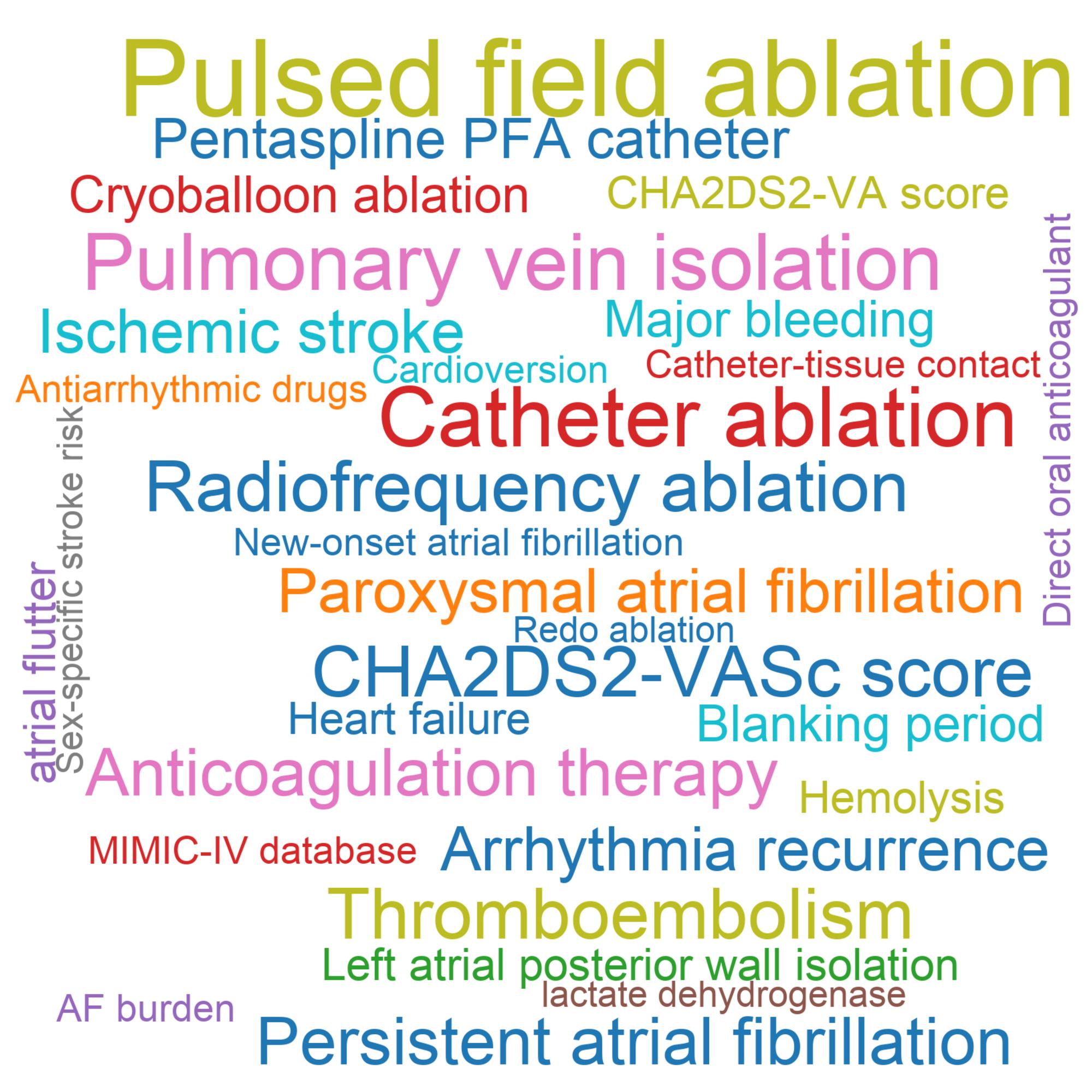
The informative word cloud across the 50 highest 18-month-cited atrial fibrillation management and outcomes papers reveals a field organized around ablation technology competition, procedural endpoints, and stroke-risk stratification rather than generic disease labels. Pulsed field ablation leads at 19 of 50 papers (normalized frequency 0.38), followed by catheter ablation (12 papers, 0.24) and pulmonary vein isolation (11 papers, 0.22)—a trio that frames how influential 2024 publications benchmark emerging energy modalities against established catheter-based isolation strategies. Radiofrequency ablation remains highly visible (9 papers, 0.18), underscoring sustained citation weight for comparative ablation trials and device-specific outcomes. A parallel cluster centers on anticoagulation and thromboembolic risk: CHA2DS2-VASc score (9 papers, 0.18), thromboembolism (9 papers, 0.18), and anticoagulation therapy (8 papers, 0.16) appear alongside rhythm-control vocabulary such as arrhythmia recurrence. Mid-sized terms highlight AF subtype framing—persistent atrial fibrillation (8 papers, 0.16)—alongside ischemic stroke and paroxysmal atrial fibrillation. Smaller but visible concepts—including pentaspline PFA catheter, blanking period, and major bleeding—signal growing emphasis on procedural innovation and clinical outcomes.
How Did Topics Shift from the Class of 2025 to the Class of 2026?
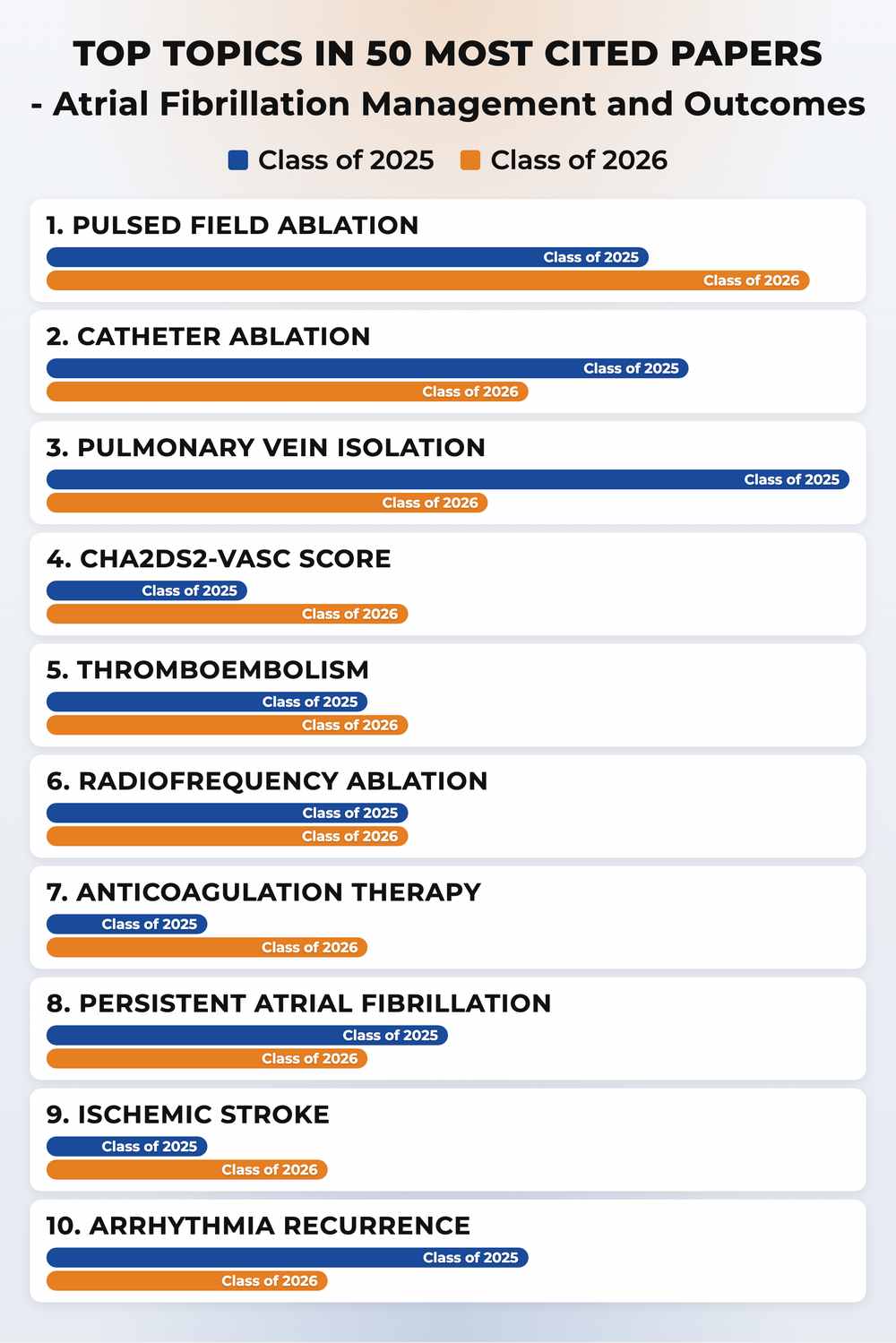
Comparing normalized concept frequencies between the Class of 2025 (2023 publications) and Class of 2026 (2024 publications) cohorts shows a reorientation of early-high-impact research priorities within atrial fibrillation management. Pulsed field ablation exhibited one of the largest gains (+0.08 normalized frequency; 15 versus 19 papers), followed by CHA2DS2-VASc score (+0.08; 5 versus 9) and anticoagulation therapy (+0.08; 4 versus 8), with additional increases for ischemic stroke (+0.06), heart failure (+0.06), and new-onset atrial fibrillation (+0.06). The topic evolution card underscores that Class of 2026 bars extend furthest for pulsed field ablation, catheter ablation, pulmonary vein isolation, and radiofrequency ablation—topics aligned with head-to-head ablation technology trials and updated guideline consensus. Conversely, several themes prominent in the Class of 2025 cohort receded: pulmonary vein isolation (−0.18), paroxysmal atrial fibrillation (−0.14), arrhythmia recurrence (−0.10), catheter ablation (−0.08), antiarrhythmic drugs (−0.08), and direct oral anticoagulant (−0.08). Cryoballoon ablation (−0.08), major bleeding (−0.08), and intracranial hemorrhage (−0.08) also declined in relative prominence. Together, these shifts suggest that the most-cited 2024 papers emphasize next-generation ablation modalities and thromboembolic risk, while paroxysmal-AF subtype framing and recurrence-centric procedural endpoints lost ground among early-high-impact work.
Methodology
PRI identifies high-impact research using a transparent, topic-agnostic framework applied consistently across scientific domains. Bibliographic records are drawn from OpenAlex, including publication dates, citation relationships, and document types.
This ranking covers the Class of 2026 cohort: journal articles published in 2024. Reviews and other non-article document types are excluded to ensure comparability.
Research impact is quantified with an 18-month post-publication citation window—the number of citing works published within 18 months of each paper's publication date. This metric captures early impact while controlling for publication age.
An LLM-based relevance classifier then reviews each candidate's title and abstract to confirm substantive alignment with the target domain. Only papers classified as relevant appear in the final ranking.
Zheng Su, Tinsley Li, Thematic Shifts in Early-High-Impact Cancer Genomics and Diagnostics Research: A Bibliometric and Semantic Analysis. bioRxiv 2026.07.04.736459; doi: https://doi.org/10.64898/2026.07.04.736459
Cite this ranking
Pepkio Research Index (PRI). Topics and Trends in Most Cited Atrial Fibrillation Management and Outcomes Papers, Class of 2026. https://pri.pepkio.com/top-papers/atrial-fibrillation-management-and-outcomes/2026. Accessed 2026-10-14.

Methodology
Zheng Su, Tinsley Li, Thematic Shifts in Early-High-Impact Cancer Genomics and Diagnostics Research: A Bibliometric and Semantic Analysis. bioRxiv 2026.07.04.736459; doi: https://doi.org/10.64898/2026.07.04.736459