
What topics and trends defined most-cited Liver Disease Diagnosis and Treatment research in the Class of 2026?
Liver disease research is dominated by MASLD, which surged to 50% frequency as legacy NAFLD terminology rapidly declined. High-impact studies increasingly pivot toward GLP-1 receptor agonists, lipid metabolism, and hepatocellular carcinoma surveillance, while traditional non-invasive tools like FibroScan show declining relative focus in favor of targeted molecular profiling.
At a glance
- Field
- Liver Disease Diagnosis and Treatment
- Cohort label
- Class of 2026 (2024 publications)
- Papers analyzed
- 20,291
- Papers ranked
- 20
- Top topics in ranked papers
- MASLD, steatohepatitis, hepatocellular carcinoma, GLP-1 receptor agonists, liver fibrosis
- Publication window
- Jan 1, 2024 – Dec 31, 2024
- Eligibility
- Research articles; reviews excluded
- Citation window
- 18 months post-publication
- 18m citation range
- 109–944
- Data source
- OpenAlex · Retrieved Jul 2026
- License
- CC BY 4.0
Rankings
20 papers ranked by 18-month citation count
A Phase 3, Randomized, Controlled Trial of Resmetirom in NASH with Liver Fibrosis
New England Journal of Medicine202410.1056/nejmoa2309000
Tirzepatide for Metabolic Dysfunction–Associated Steatohepatitis with Liver Fibrosis
New England Journal of Medicine202410.1056/nejmoa2401943
Current status and future trends of the global burden of MASLD
Trends in Endocrinology and Metabolism202410.1016/j.tem.2024.02.007
A Phase 2 Randomized Trial of Survodutide in MASH and Fibrosis
New England Journal of Medicine202410.1056/nejmoa2401755
Metabolic dysfunction-associated steatotic liver disease: heterogeneous pathomechanisms and effectiveness of metabolism-based treatment
The Lancet Diabetes & Endocrinology202410.1016/s2213-8587(24)00318-8
Global burden of metabolic diseases, 1990–2021
Metabolism202410.1016/j.metabol.2024.155999
Atlas of the plasma proteome in health and disease in 53,026 adults
Cell202410.1016/j.cell.2024.10.045
Natural history and progression of metabolic dysfunction-associated steatotic liver disease
The Lancet. Gastroenterology & hepatology202410.1016/s2468-1253(24)00193-6
Clinical profiles and mortality rates are similar for metabolic dysfunction-associated steatotic liver disease and non-alcoholic fatty liver disease
Journal of Hepatology202410.1016/j.jhep.2024.01.014
Gut symbionts alleviate MASH through a secondary bile acid biosynthetic pathway
Cell202410.1016/j.cell.2024.03.034
Liver cancer in 2021: Global Burden of Disease study
Journal of Hepatology202410.1016/j.jhep.2024.10.031
An unbiased ranking of murine dietary models based on their proximity to human metabolic dysfunction-associated steatotic liver disease (MASLD)
Nature Metabolism202410.1038/s42255-024-01043-6
Triple hormone receptor agonist retatrutide for metabolic dysfunction-associated steatotic liver disease: a randomized phase 2a trial
Nature Medicine202410.1038/s41591-024-03018-2
The Global Epidemiology of Nonalcoholic Fatty Liver Disease and Nonalcoholic Steatohepatitis Among Patients With Type 2 Diabetes
Clinical Gastroenterology and Hepatology202410.1016/j.cgh.2024.03.006
Genome-wide characterization of circulating metabolic biomarkers
Nature202410.1038/s41586-024-07148-y
Data-driven cluster analysis identifies distinct types of metabolic dysfunction-associated steatotic liver disease
Nature Medicine202410.1038/s41591-024-03283-1
The underappreciated diversity of bile acid modifications
Cell202410.1016/j.cell.2024.02.019
Low-to-moderate alcohol consumption is associated with increased fibrosis in individuals with metabolic dysfunction-associated steatotic liver disease
Journal of Hepatology202410.1016/j.jhep.2024.06.036
Semaglutide 2.4 mg in Participants With Metabolic Dysfunction‐Associated Steatohepatitis: Baseline Characteristics and Design of the Phase 3 <scp>ESSENCE</scp> Trial
Alimentary Pharmacology & Therapeutics202410.1111/apt.18331
Vibration-Controlled Transient Elastography Scores to Predict Liver-Related Events in Steatotic Liver Disease
JAMA202410.1001/jama.2024.1447
Topic trends
Dominant research themes and year-over-year shifts in Liver Disease Diagnosis and Treatment
What Topics Define the Class of 2026?
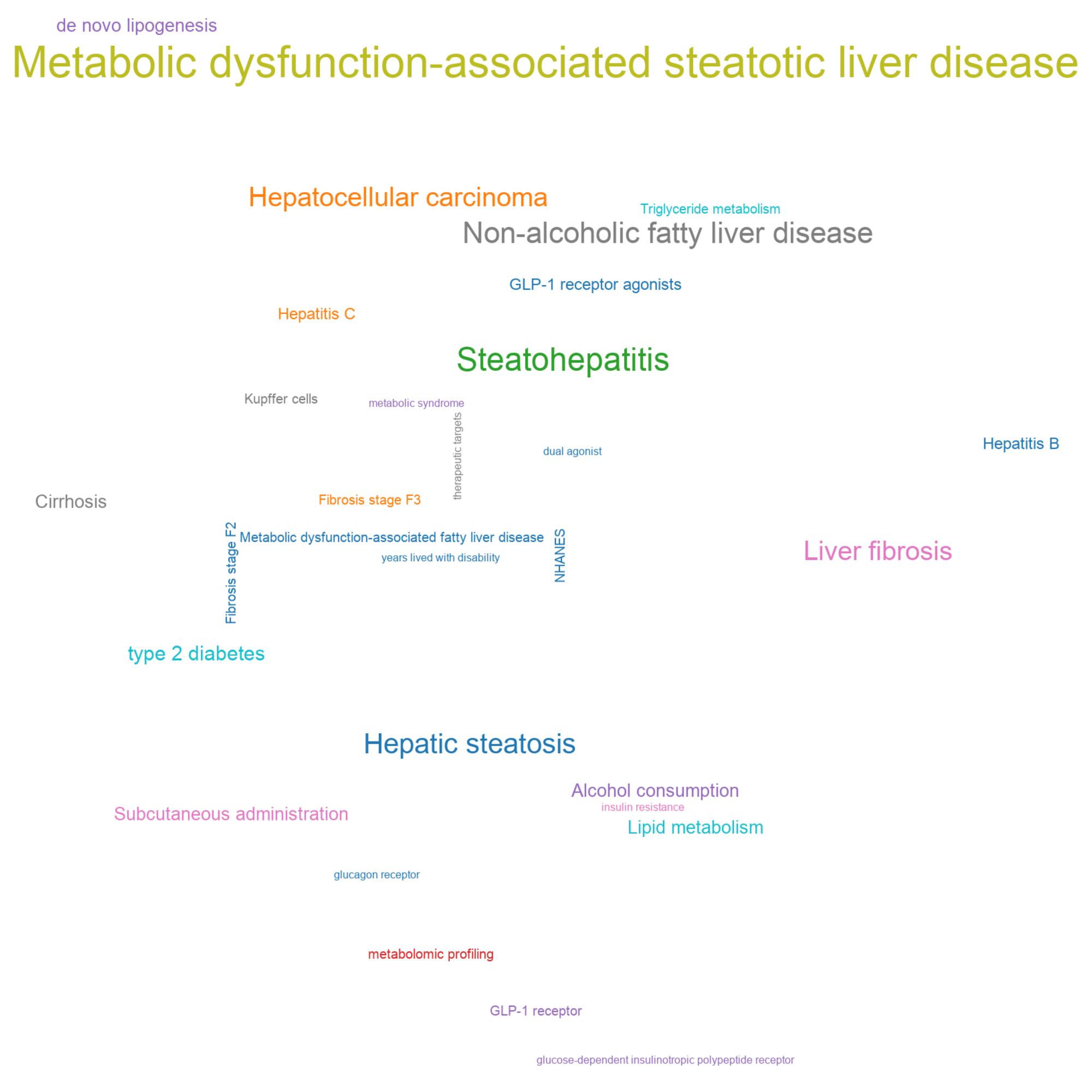
The Class of 2026 in liver disease research is anchored by a landmark shift toward metabolic liver disorders, led by Metabolic Dysfunction-Associated Steatotic Liver Disease (MASLD). MASLD appears in 50% of the top-ranked cohort (25 papers), reflecting international consensus adoption of revised terminology over legacy non-alcoholic fatty liver disease (NAFLD). Secondary metabolic markers including steatohepatitis (28%) and hepatic steatosis (22%) demonstrate strong co-occurrence, illustrating a concentrated focus on non-invasive diagnosis and disease staging. Beyond metabolic dysfunction, research heavily emphasizes end-stage liver complications and oncological progression. Hepatocellular carcinoma (HCC) is featured in 20% of high-impact studies, driven by innovations in early surveillance and combination immunotherapies. Meanwhile, liver fibrosis (20%) and cirrhosis (10%) represent central clinical endpoints, with growing attention to histological staging (F2 and F3 stages). Mechanistically, the cohort exhibits high density around metabolic regulators and therapeutic pathways. Type 2 diabetes (12%), de novo lipogenesis (10%), and GLP-1 receptor agonists (8%) reflect an expanding pharmacological paradigm linking metabolic health to hepatic outcomes. Together, these thematic clusters highlight a research trajectory focused on precision diagnosis, metabolic targeted therapies, and early risk stratification.
How Did Topics Shift from the Class of 2025 to the Class of 2026?
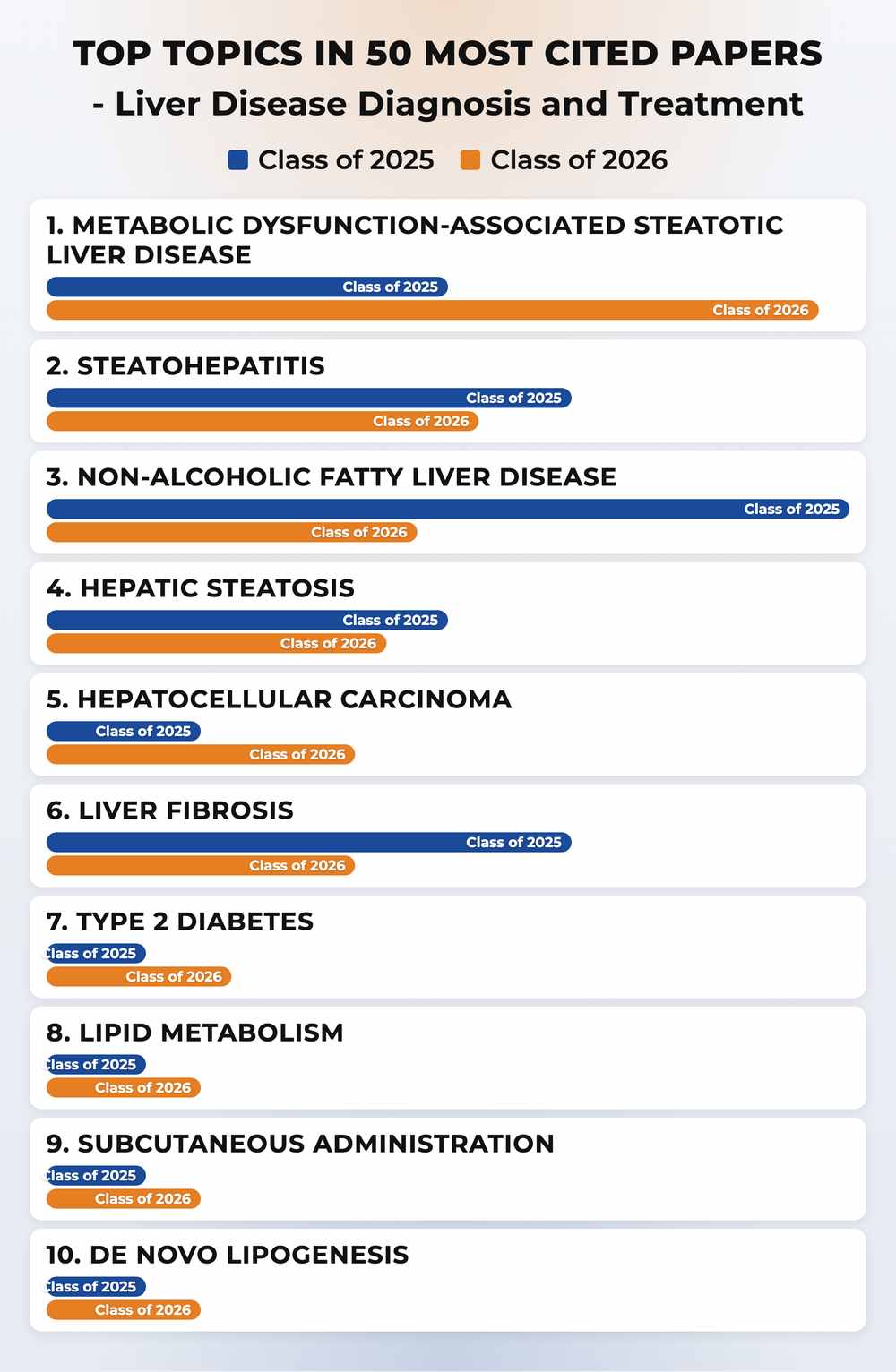
The shift between the Class of 2025 and Class of 2026 reflects an active evolution in hepatology nomenclature, therapeutic targets, and diagnostic modalities. Most prominently, Metabolic Dysfunction-Associated Steatotic Liver Disease (MASLD) nearly doubled in normalized frequency (from 0.26 to 0.50, a 1.92-fold increase). Conversely, legacy Non-Alcoholic Fatty Liver Disease (NAFLD) experienced a steep decline from 0.52 to 0.24 (a 54% reduction), marking rapid community-wide adoption of updated diagnostic frameworks. Pharmacological and mechanistic themes represent the fastest-rising research frontiers. Incretin-based therapeutics surged, led by GLP-1 receptor agonists (rising from 0.04 to 0.08) and novel GLP-1 receptor studies. Metabolic pathways such as lipid metabolism (5-fold increase to 0.10), de novo lipogenesis (2.5-fold increase), and subcutaneous drug delivery gained significant traction. Additionally, hepatocellular carcinoma (HCC) doubled its relative presence from 0.10 to 0.20, pointing to intensified focus on liver cancer in metabolic cohorts. In contrast, broad descriptive terms and conventional diagnostic tools showed relative declines. FibroScan usage diminished in mention frequency (0.14 to 0.04), as studies pivoted toward novel serum biomarkers and multi-omic profiling. Broad conditions like alcohol-related liver disease and general liver fibrosis also yielded relative frequency to specific metabolic and histological sub-phenotypes.
Methodology
PRI identifies high-impact research using a transparent, topic-agnostic framework applied consistently across scientific domains. Bibliographic records are drawn from OpenAlex, including publication dates, citation relationships, and document types.
This ranking covers the Class of 2026 cohort: journal articles published in 2024. Reviews and other non-article document types are excluded to ensure comparability.
Research impact is quantified with an 18-month post-publication citation window—the number of citing works published within 18 months of each paper's publication date. This metric captures early impact while controlling for publication age.
An LLM-based relevance classifier then reviews each candidate's title and abstract to confirm substantive alignment with the target domain. Only papers classified as relevant appear in the final ranking.
Zheng Su, Tinsley Li, Thematic Shifts in Early-High-Impact Cancer Genomics and Diagnostics Research: A Bibliometric and Semantic Analysis. bioRxiv 2026.07.04.736459; doi: https://doi.org/10.64898/2026.07.04.736459
Cite this ranking
Pepkio Research Index (PRI). Topics and Trends in Most Cited Liver Disease Diagnosis and Treatment Papers, Class of 2026. https://pri.pepkio.com/top-papers/liver-disease-diagnosis-and-treatment/2026. Accessed 2026-10-21.

Methodology
Zheng Su, Tinsley Li, Thematic Shifts in Early-High-Impact Cancer Genomics and Diagnostics Research: A Bibliometric and Semantic Analysis. bioRxiv 2026.07.04.736459; doi: https://doi.org/10.64898/2026.07.04.736459