
What topics and trends defined most-cited Heart Failure Treatment and Management research in the Class of 2026?
In 2024, research on heart failure shifted heavily toward addressing heart failure with preserved ejection fraction (HFpEF) and obesity-related complications. Major clinical trials, particularly FINEARTS-HF, drove interest in GLP-1 receptor agonists and mineralocorticoid receptor antagonists, while focus on SGLT2 inhibitors and beta-blockers declined.
At a glance
- Field
- Heart Failure Treatment and Management
- Cohort label
- Class of 2026 (2024 publications)
- Papers analyzed
- 6,981
- Papers ranked
- 20
- Top topics in ranked papers
- Heart failure with preserved ejection fraction, cardiovascular mortality, GLP-1 receptor agonists, mineralocorticoid receptor antagonists
- Publication window
- Jan 1, 2024 – Dec 31, 2024
- Eligibility
- Research articles; reviews excluded
- Citation window
- 18 months post-publication
- 18m citation range
- 60–727
- Data source
- OpenAlex · Retrieved Jul 2026
- License
- CC BY 4.0
Rankings
20 papers ranked by 18-month citation count
Tirzepatide for Heart Failure with Preserved Ejection Fraction and Obesity
New England Journal of Medicine202410.1056/nejmoa2410027
Finerenone in Heart Failure with Mildly Reduced or Preserved Ejection Fraction
New England Journal of Medicine202410.1056/nejmoa2407107
Semaglutide in Patients with Obesity-Related Heart Failure and Type 2 Diabetes
New England Journal of Medicine202410.1056/nejmoa2313917
Semaglutide versus placebo in people with obesity-related heart failure with preserved ejection fraction: a pooled analysis of the STEP-HFpEF and STEP-HFpEF DM randomised trials
The Lancet202410.1016/s0140-6736(24)00469-0
Semaglutide versus placebo in patients with heart failure and mildly reduced or preserved ejection fraction: a pooled analysis of the SELECT, FLOW, STEP-HFpEF, and STEP-HFpEF DM randomised trials
The Lancet202410.1016/s0140-6736(24)01643-x
Semaglutide and cardiovascular outcomes in patients with obesity and prevalent heart failure: a prespecified analysis of the SELECT trial
The Lancet202410.1016/s0140-6736(24)01498-3
Intensive Blood-Pressure Control in Patients with Type 2 Diabetes
New England Journal of Medicine202410.1056/nejmoa2412006
Beta-Blocker Interruption or Continuation after Myocardial Infarction
New England Journal of Medicine202410.1056/nejmoa2404204
Effects of tirzepatide on circulatory overload and end-organ damage in heart failure with preserved ejection fraction and obesity: a secondary analysis of the SUMMIT trial
Nature Medicine202410.1038/s41591-024-03374-z
Effect of Semaglutide on Cardiac Structure and Function in Patients With Obesity-Related Heart Failure
Journal of the American College of Cardiology202410.1016/j.jacc.2024.08.021
Effects of Semaglutide on Heart Failure Outcomes in Diabetes and Chronic Kidney Disease in the FLOW Trial
Journal of the American College of Cardiology202410.1016/j.jacc.2024.08.004
Comparative study on the predictive value of TG/HDL-C, TyG and TyG-BMI indices for 5-year mortality in critically ill patients with chronic heart failure: a retrospective study
Cardiovascular Diabetology202410.1186/s12933-024-02308-w
Efficacy and Safety of Dapagliflozin in Patients With Acute Heart Failure
Journal of the American College of Cardiology202410.1016/j.jacc.2024.02.009
Effect of combination treatment with glucagon-like peptide-1 receptor agonists and sodium-glucose cotransporter-2 inhibitors on incidence of cardiovascular and serious renal events: population based cohort study
BMJ202410.1136/bmj-2023-078242
Long-term effect of mavacamten in obstructive hypertrophic cardiomyopathy
European Heart Journal202410.1093/eurheartj/ehae579
Inflammation in Obesity-Related HFpEF
Journal of the American College of Cardiology202410.1016/j.jacc.2024.08.028
Indole-3-Propionic Acid Protects Against Heart Failure With Preserved Ejection Fraction
Circulation Research202410.1161/circresaha.123.322381
Semaglutide and NT-proBNP in Obesity-Related HFpEF
Journal of the American College of Cardiology202410.1016/j.jacc.2024.04.022
Finerenone and Kidney Outcomes in Patients With Heart Failure
Journal of the American College of Cardiology202410.1016/j.jacc.2024.10.091
The traditional Chinese medicine Qiliqiangxin in heart failure with reduced ejection fraction: a randomized, double-blind, placebo-controlled trial
Nature Medicine202410.1038/s41591-024-03169-2
Topic trends
Dominant research themes and year-over-year shifts in Heart Failure Treatment and Management
What Topics Define the Class of 2026?
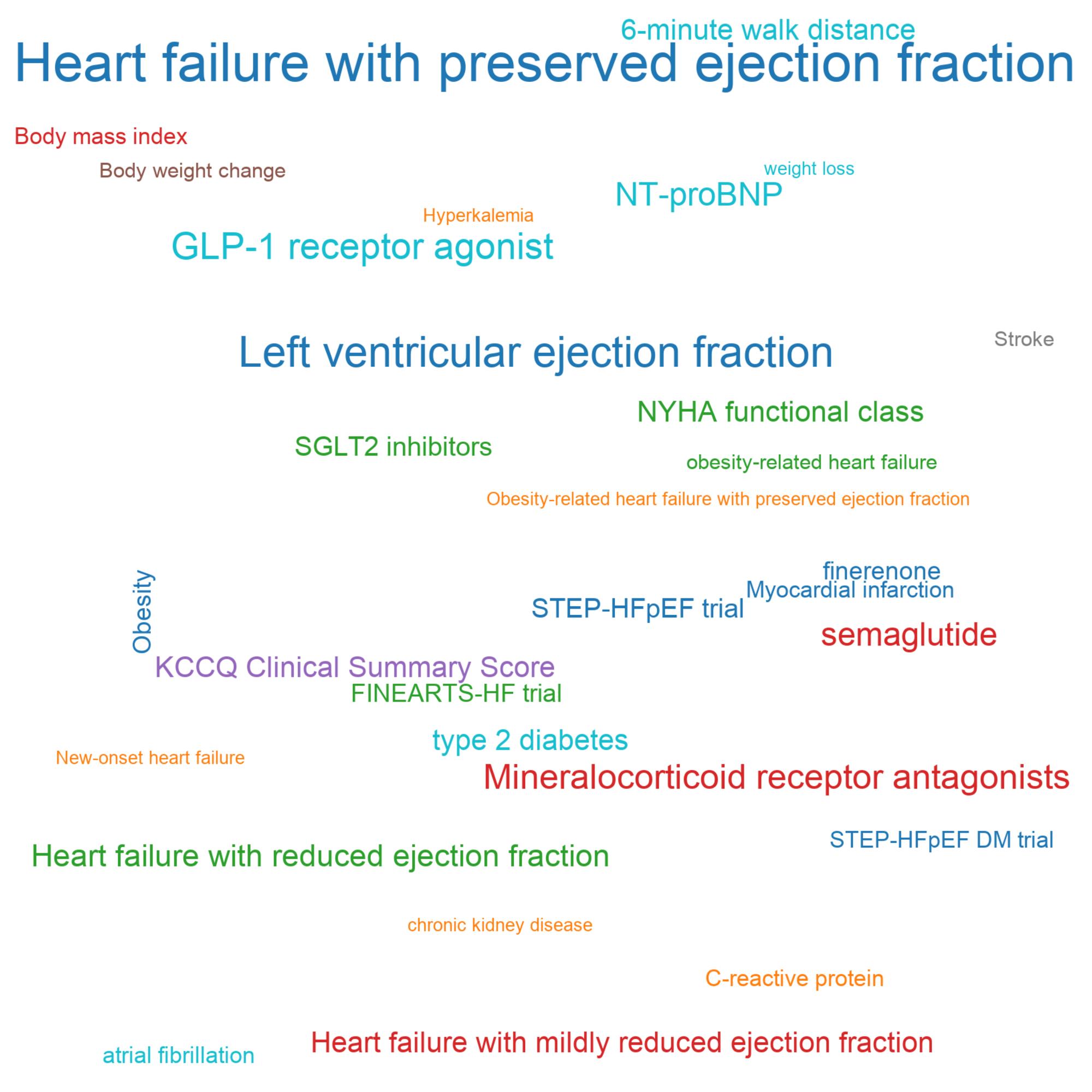
The Class of 2026 research in heart failure is overwhelmingly defined by treatments and outcomes for heart failure with preserved ejection fraction (HFpEF). Ejection fraction remains the central metric of interest, alongside cardiovascular mortality. However, the most distinctive trend is the surge in pharmacological interventions specifically targeting metabolic and obesity-related pathways in heart failure. GLP-1 receptor agonists have emerged as a dominant area of focus, reflecting the growing recognition of the intersection between cardiovascular disease and obesity. Similarly, mineralocorticoid receptor antagonists have garnered significant attention, solidifying their role in modern heart failure management. These trends indicate a shift towards precision pharmacology and addressing systemic metabolic factors rather than isolated cardiac dysfunction.
How Did Topics Shift from the Class of 2025 to the Class of 2026?
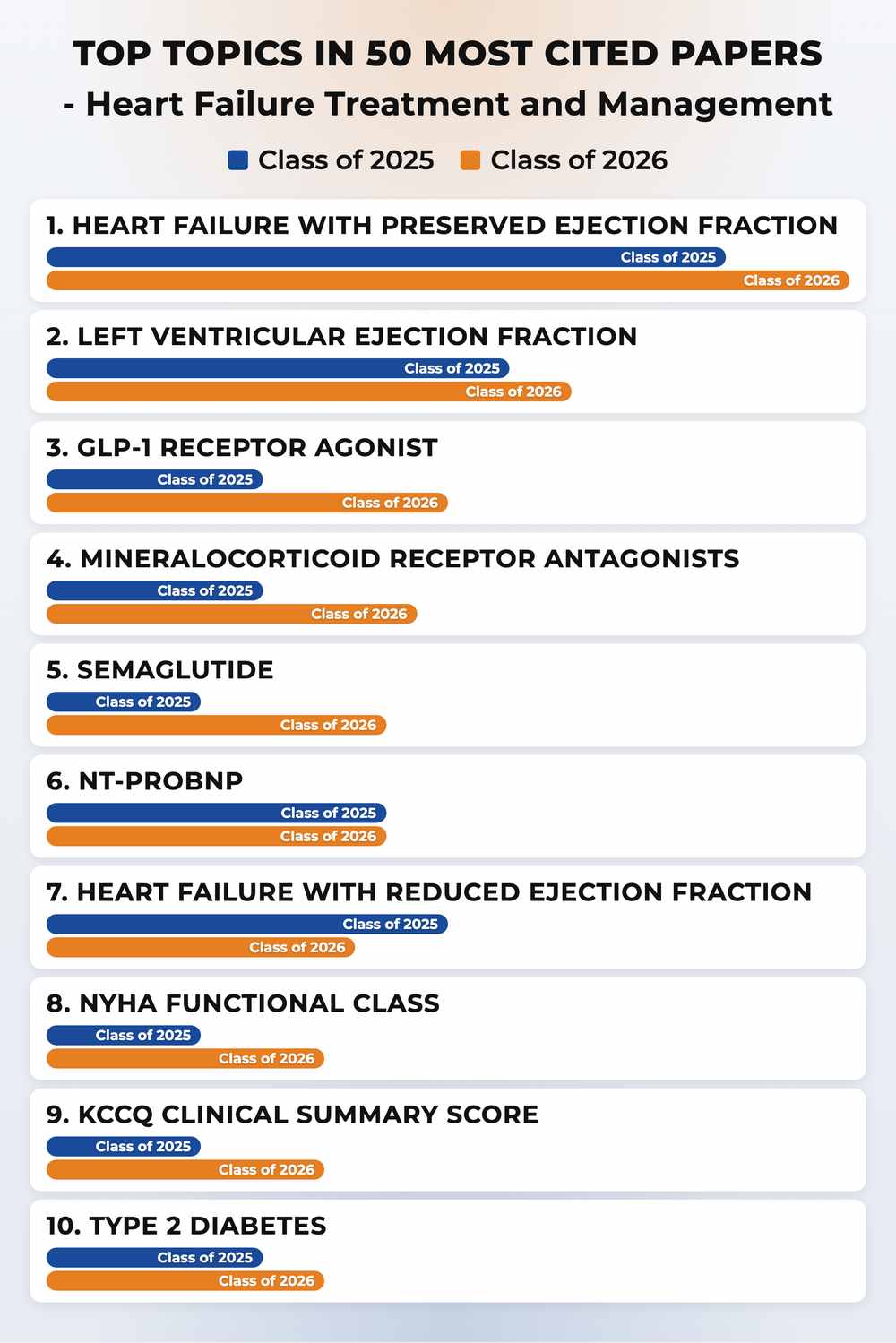
The shift from 2025 to 2026 reveals a dramatic pivot in clinical trial focus and therapeutic strategies. The FINEARTS-HF trial saw an unprecedented rise, driving much of the discourse around new interventions. Correspondingly, research into obesity-related heart failure and weight loss therapies surged, aligning with the rise of GLP-1 receptor agonists. Conversely, previously dominant topics experienced notable declines. SGLT2 inhibitors, having been heavily researched in prior years and established in clinical guidelines, saw reduced relative focus. Research concerning the Kansas City Cardiomyopathy Questionnaire and traditional beta-blockers also decreased. This transition underscores a movement past foundational therapies towards novel, metabolically driven treatments for specific heart failure subpopulations.
Methodology
PRI identifies high-impact research using a transparent, topic-agnostic framework applied consistently across scientific domains. Bibliographic records are drawn from OpenAlex, including publication dates, citation relationships, and document types.
This ranking covers the Class of 2026 cohort: journal articles published in 2024. Reviews and other non-article document types are excluded to ensure comparability.
Research impact is quantified with an 18-month post-publication citation window—the number of citing works published within 18 months of each paper's publication date. This metric captures early impact while controlling for publication age.
An LLM-based relevance classifier then reviews each candidate's title and abstract to confirm substantive alignment with the target domain. Only papers classified as relevant appear in the final ranking.
Zheng Su, Tinsley Li, Thematic Shifts in Early-High-Impact Cancer Genomics and Diagnostics Research: A Bibliometric and Semantic Analysis. bioRxiv 2026.07.04.736459; doi: https://doi.org/10.64898/2026.07.04.736459
Cite this ranking
Pepkio Research Index (PRI). Topics and Trends in Most Cited Heart Failure Treatment and Management Papers, Class of 2026. https://pri.pepkio.com/top-papers/heart-failure-treatment-and-management/2026. Accessed 2026-10-14.

Methodology
Zheng Su, Tinsley Li, Thematic Shifts in Early-High-Impact Cancer Genomics and Diagnostics Research: A Bibliometric and Semantic Analysis. bioRxiv 2026.07.04.736459; doi: https://doi.org/10.64898/2026.07.04.736459