
What topics and trends defined most-cited Lepidoptera: Biology and Taxonomy research in the Class of 2026?
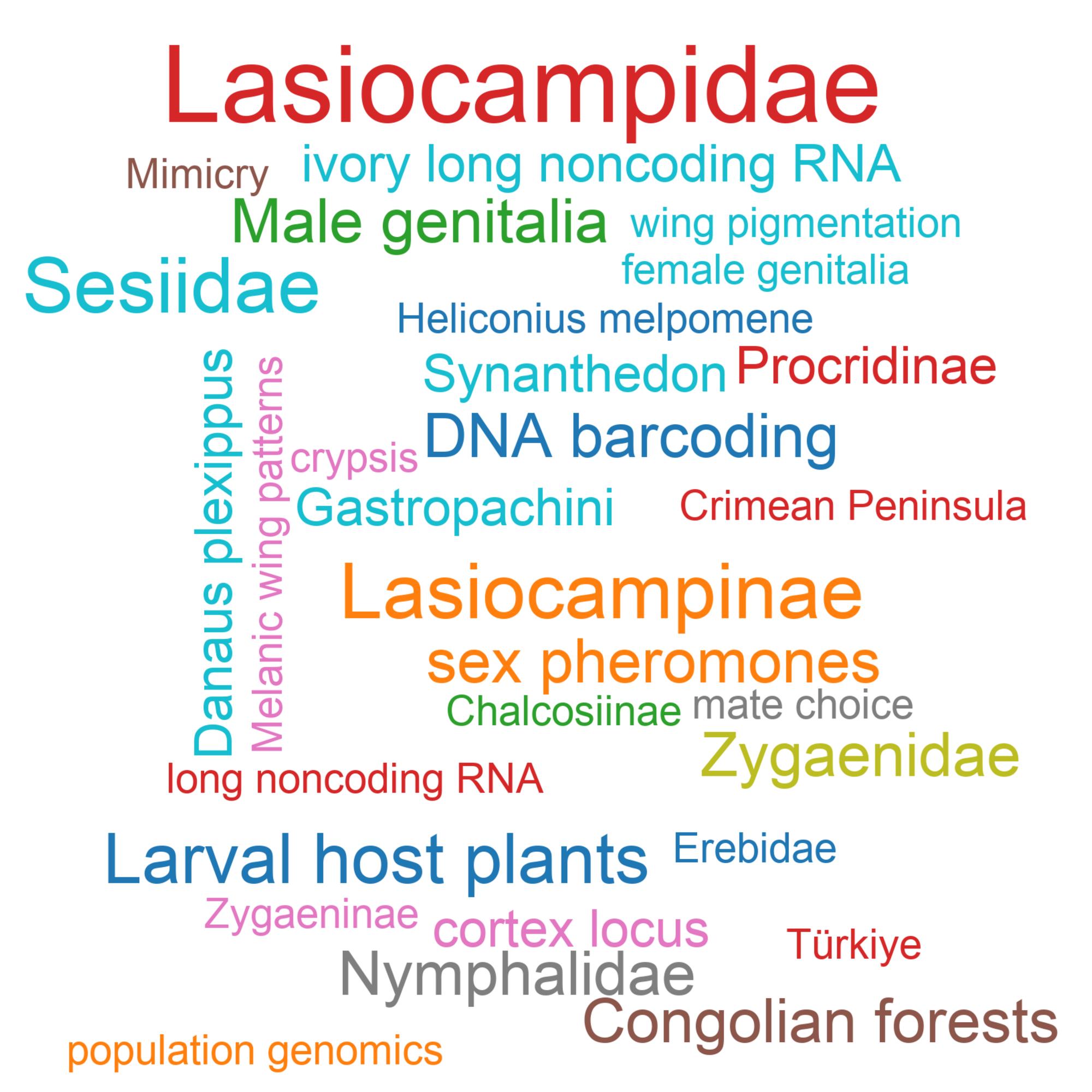
The Class of 2026 highlights a shift towards chemical ecology and molecular mechanisms, with novel focuses on sex pheromones and specific genetic markers like the cortex locus. While traditional taxonomy using DNA barcoding and morphology remains foundational, ecological studies on larval host plants and specific families like Sesiidae and Zygaenidae are rapidly expanding.
At a glance
- Field
- Lepidoptera: Biology and Taxonomy
- Cohort label
- Class of 2026 (2024 publications)
- Papers analyzed
- 3,163
- Papers ranked
- 20
- Top topics in ranked papers
- Lasiocampidae, Sesiidae, Larval host plants
- Publication window
- Jan 1, 2024 – Dec 31, 2024
- Eligibility
- Research articles; reviews excluded
- Citation window
- 18 months post-publication
- 18m citation range
- 10–115
- Data source
- OpenAlex · Retrieved June 2026
- License
- CC BY 4.0
Rankings
20 papers ranked by 18-month citation count
Comparative genomics reveals the dynamics of chromosome evolution in Lepidoptera
Nature Ecology & Evolution202410.1038/s41559-024-02329-4
Hybrid speciation driven by multilocus introgression of ecological traits
Nature202410.1038/s41586-024-07263-w
On the terminology of the genitalia structures of lichen moths (Lepidoptera: Erebidae: Arctiinae: Lithosiini) with some references to Noctuidae
Ecologica Montenegrina202410.37828/em.2024.73.18
Complete checklist of Burmese (Myanmar) amber taxa 2023
Mesozoic202410.11646/mesozoic.1.1.4
A microRNA is the effector gene of a classic evolutionary hotspot locus
Science202410.1126/science.adp7899
Adaptive introgression of a visual preference gene
Science202410.1126/science.adj9201
An annotated catalogue of the Procridinae of the World (Lepidoptera: Zygaenidae)
SHILAP Revista de lepidopterología202410.57065/shilap.956
A long noncoding RNA at the cortex locus controls adaptive coloration in butterflies
Proceedings of the National Academy of Sciences202410.1073/pnas.2403326121
The ivory lncRNA regulates seasonal color patterns in buckeye butterflies
Proceedings of the National Academy of Sciences202410.1073/pnas.2403426121
First comprehensive higher level phylogeny of Zygaenidae (Lepidoptera) including estimated ages of the major lineages and a review of known zygaenid fossils
Systematic Entomology202410.1111/syen.12634
The actin cytoskeleton plays multiple roles in structural colour formation in butterfly wing scales
Nature Communications202410.1038/s41467-024-48060-3
Sonitha adetoun – a new species from the Congolian lowland forests (Lepidoptera, Lasiocampidae, Lasiocampinae, Gastropachini)
Ecologica Montenegrina202410.37828/em.2024.72.6
New data on the distribution and biology of Jordanita (Roccia) volgensis (Möschler, 1862) (Lepidoptera: Zygaenidae, Procridinae) in the Crimea
Ecologica Montenegrina202410.37828/em.2024.80.15
First record of the genus Zygaenoprocris Hampson, 1900 (Lepidoptera: Zygaenidae) from Türkiye (Turkey)
Ecologica Montenegrina202410.37828/em.2024.79.17
W chromosome sequences of two bombycid moths provide an insight into the origin of Fem
Molecular Ecology202410.1111/mec.17434
Descriptions of new Hypotrabala Holland, 1893 (Lepidoptera: Lasiocampidae: Lasiocampinae: Selenepherini) in the collections of the African Natural History Research Trust, with notes on allied genera and the description of a new genus
Ecologica Montenegrina202410.37828/em.2024.72.4
Four new species close to Sonitha libera and Sonitha myoctona from the Congolian lowland forests (Lepidoptera, Lasiocampidae)
Ecologica Montenegrina202410.37828/em.2024.72.9
Two new species for the Afrotropic genus Leptometa: Leptometa danieli and Leptometa gabrielae (Lepidoptera, Lasiocampidae)
Ecologica Montenegrina202410.37828/em.2024.71.5
A new genus Meyameta for South African “Napta” straminea and description of its sister species from Namibia (Lepidoptera, Lasiocampidae)
Ecologica Montenegrina202410.37828/em.2024.71.16
A new species of the genus Bembecia Hübner, 1819 (Lepidoptera: Sesiidae) from the Volga region
Euroasian Entomological Journal202410.15298/rusentj.33.3.11
Topic trends
Dominant research themes and year-over-year shifts in Lepidoptera: Biology and Taxonomy
What Topics Define the Class of 2026?
In the Class of 2026 for Lepidoptera Biology and Taxonomy, the research landscape is prominently defined by studies focusing on specific moth and butterfly families, most notably Lasiocampidae and Lasiocampinae, as well as an emergent emphasis on Sesiidae and Zygaenidae. The integration of advanced molecular techniques is evident through the widespread application of DNA barcoding, which remains a fundamental tool for species identification and phylogenetic analysis. Concurrently, traditional morphological assessments, such as the detailed examination of male genitalia, continue to be a cornerstone of taxonomic classifications. Ecological and behavioral themes also form a significant portion of the cohort's focus. Researchers are increasingly investigating larval host plants and sex pheromones, highlighting a shift towards understanding the complex ecological interactions and chemical ecology of Lepidoptera. Geographically, there is a notable concentration of studies centered on the Congolian forests, reflecting an ongoing effort to document and conserve biodiversity in this critical Afrotropical region. Together, these topics illustrate a field that seamlessly blends classical taxonomy with modern molecular methods and ecological research to deepen our understanding of lepidopteran diversity and evolution.
How Did Topics Shift from the Class of 2025 to the Class of 2026?
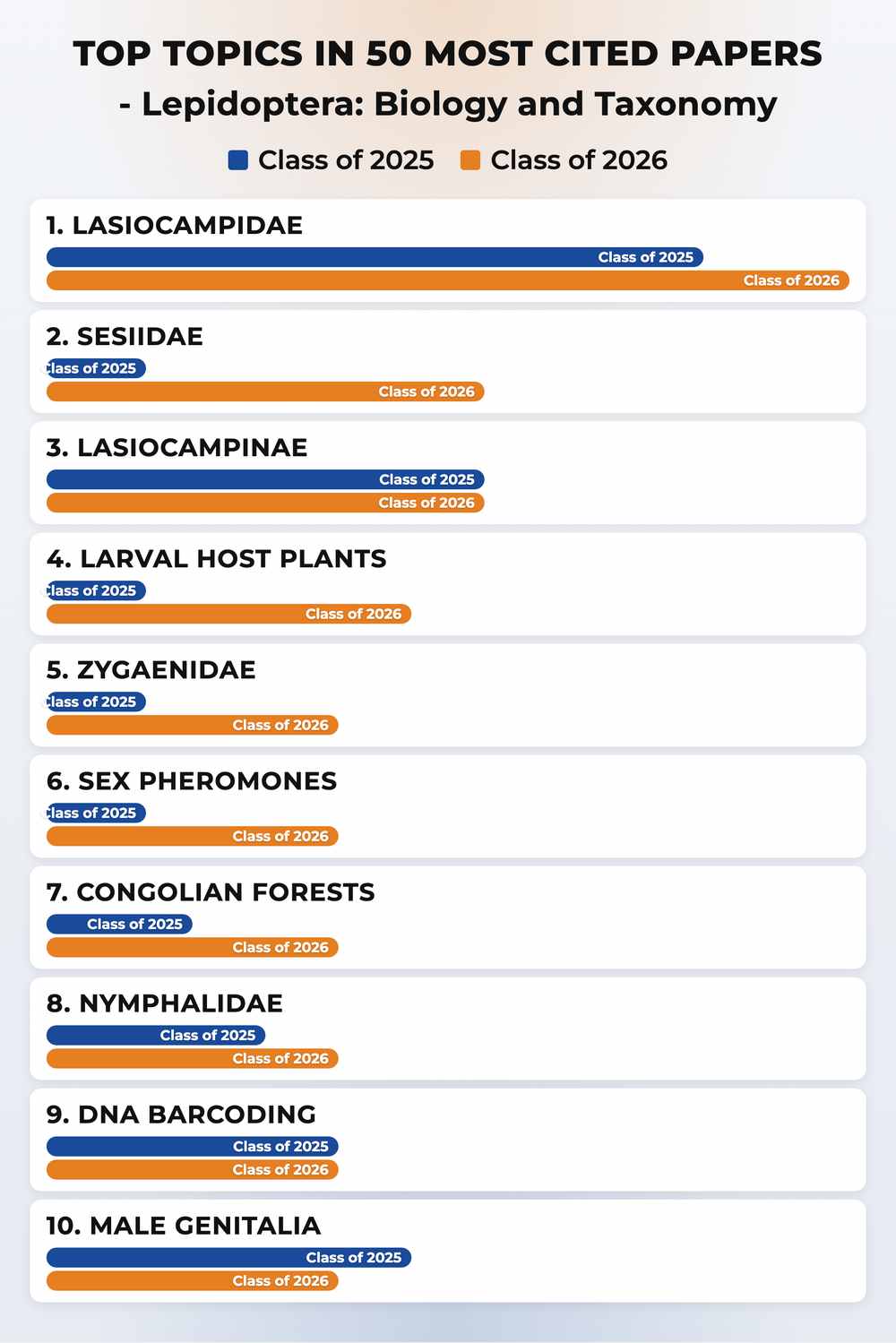
The transition from the Class of 2025 to the Class of 2026 reveals a dynamic shift in the research priorities within Lepidoptera Biology and Taxonomy. The most striking trend is the rapid emergence of entirely new areas of focus that were virtually absent in the previous year. Studies centered on Zygaenidae, Procridinae, and specific genera like Synanthedon have surged, alongside a novel focus on sex pheromones and genetic markers such as the cortex locus and ivory long noncoding RNA. This indicates a growing interest in the chemical ecology and the genetic mechanisms underlying phenotypic traits in these specific groups. Furthermore, there is a substantial proportional increase in research dedicated to Sesiidae and larval host plants, with the latter seeing a five-fold rise in frequency. This underscores a broader shift towards examining the ecological dependencies and evolutionary adaptations of moths and butterflies. While traditional morphological studies and broad regional surveys—such as those focusing on male genitalia and the general Afrotropical region—have seen a slight decline, localized ecological studies, particularly those investigating the Congolian forests, have doubled. Overall, these shifts highlight a field rapidly expanding its methodological toolkit from classical morphology to intricate genetic and chemical analyses.
Methodology
PRI identifies high-impact research using a transparent, topic-agnostic framework applied consistently across scientific domains. Bibliographic records are drawn from OpenAlex, including publication dates, citation relationships, and document types.
This ranking covers the Class of 2026 cohort: journal articles published in 2024. Reviews and other non-article document types are excluded to ensure comparability.
Research impact is quantified with an 18-month post-publication citation window—the number of citing works published within 18 months of each paper's publication date. This metric captures early impact while controlling for publication age.
An LLM-based relevance classifier then reviews each candidate's title and abstract to confirm substantive alignment with the target domain. Only papers classified as relevant appear in the final ranking.
Zheng Su, Tinsley Li, Thematic Shifts in Early-High-Impact Cancer Genomics and Diagnostics Research: A Bibliometric and Semantic Analysis. bioRxiv 2026.07.04.736459; doi: https://doi.org/10.64898/2026.07.04.736459
Cite this ranking
Pepkio Research Index (PRI). Topics and Trends in Most Cited Lepidoptera: Biology and Taxonomy Papers, Class of 2026. https://pri.pepkio.com/top-papers/lepidoptera-biology-and-taxonomy/2026. Accessed 2026-10-24.

Methodology
Zheng Su, Tinsley Li, Thematic Shifts in Early-High-Impact Cancer Genomics and Diagnostics Research: A Bibliometric and Semantic Analysis. bioRxiv 2026.07.04.736459; doi: https://doi.org/10.64898/2026.07.04.736459