
What topics and trends defined most-cited Alzheimer's disease research and treatments research in the Class of 2026?
The Class of 2026 is dominated by quantitative Alzheimer's biomarkers, led by Amyloid PET, p-tau217, and the Aβ42/40 ratio. Tau PET and plasma assays surged significantly as non-invasive diagnostic tools, while general terms like tau accumulation and broad neuroinflammation saw relative declines, marking a decisive shift toward precise molecular staging.
At a glance
- Field
- Alzheimer's disease research and treatments
- Cohort label
- Class of 2026 (2024 publications)
- Papers analyzed
- 8,656
- Papers ranked
- 20
- Top topics in ranked papers
- Amyloid PET, p-tau217, Aβ42/40 ratio, Cerebrospinal fluid biomarkers, Mild cognitive impairment
- Publication window
- Jan 1, 2024 – Dec 31, 2024
- Eligibility
- Research articles; reviews excluded
- Citation window
- 18 months post-publication
- 18m citation range
- 94–405
- Data source
- OpenAlex · Retrieved Jul 2026
- License
- CC BY 4.0
Rankings
20 papers ranked by 18-month citation count
Neuroinflammation in Alzheimer disease
Nature reviews. Immunology202410.1038/s41577-024-01104-7
Diagnostic Accuracy of a Plasma Phosphorylated Tau 217 Immunoassay for Alzheimer Disease Pathology
JAMA Neurology202410.1001/jamaneurol.2023.5319
Highly accurate blood test for Alzheimer’s disease is similar or superior to clinical cerebrospinal fluid tests
Nature Medicine202410.1038/s41591-024-02869-z
APOE4 homozygosity represents a distinct genetic form of Alzheimer’s disease
Nature Medicine202410.1038/s41591-024-02931-w
Blood Biomarkers to Detect Alzheimer Disease in Primary Care and Secondary Care
JAMA202410.1001/jama.2024.13855
Biomarker Changes during 20 Years Preceding Alzheimer’s Disease
New England Journal of Medicine202410.1056/nejmoa2310168
Integrated multimodal cell atlas of Alzheimer’s disease
Nature Neuroscience202410.1038/s41593-024-01774-5
Alzheimer's disease drug development pipeline: 2024
Alzheimer s & Dementia Translational Research & Clinical Interventions202410.1002/trc2.12465
Plasma proteomic profiles predict future dementia in healthy adults
Nature Aging202410.1038/s43587-023-00565-0
Restoring hippocampal glucose metabolism rescues cognition across Alzheimer’s disease pathologies
Science202410.1126/science.abm6131
Cellular and pathological functions of tau
Nature Reviews Molecular Cell Biology202410.1038/s41580-024-00753-9
Associations of semaglutide with first‐time diagnosis of Alzheimer's disease in patients with type 2 diabetes: Target trial emulation using nationwide real‐world data in the US
Alzheimer s & Dementia202410.1002/alz.14313
Head‐to‐head comparison of leading blood tests for Alzheimer's disease pathology
Alzheimer s & Dementia202410.1002/alz.14315
Microglia rescue neurons from aggregate-induced neuronal dysfunction and death through tunneling nanotubes
Neuron202410.1016/j.neuron.2024.06.029
Revised criteria for the diagnosis and staging of Alzheimer’s disease
Nature Medicine202410.1038/s41591-024-02988-7
Multifaceted roles of APOE in Alzheimer disease
Nature Reviews Neurology202410.1038/s41582-024-00988-2
Cerebrospinal fluid proteomics in patients with Alzheimer’s disease reveals five molecular subtypes with distinct genetic risk profiles
Nature Aging202410.1038/s43587-023-00550-7
Effects of intensive lifestyle changes on the progression of mild cognitive impairment or early dementia due to Alzheimer’s disease: a randomized, controlled clinical trial
Alzheimer s Research & Therapy202410.1186/s13195-024-01482-z
Biomarker-based staging of Alzheimer disease: rationale and clinical applications
Nature Reviews Neurology202410.1038/s41582-024-00942-2
Diagnostic performance of plasma pTau217, pTau181, Aβ1-42 and Aβ1-40 in the LUMIPULSE automated platform for the detection of Alzheimer disease
Alzheimer s Research & Therapy202410.1186/s13195-024-01513-9
Topic trends
Dominant research themes and year-over-year shifts in Alzheimer's disease research and treatments
What Topics Define the Class of 2026 in Alzheimer's Disease Research?
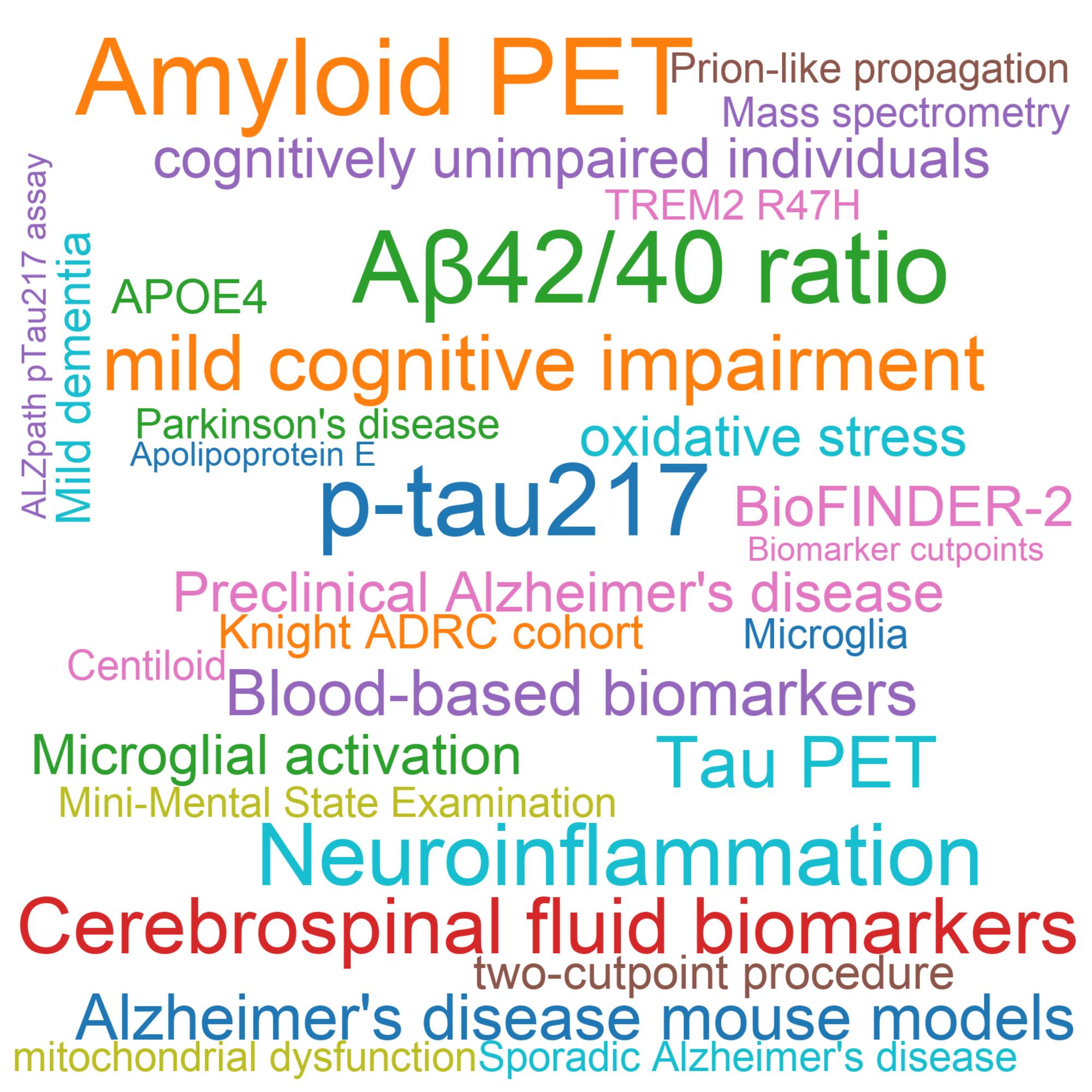
The Class of 2026 in Alzheimer's disease research is heavily defined by high-precision fluid biomarkers and advanced neuroimaging modalities. Leading the field is Amyloid PET (present in 20% of top-cited publications), reflecting its role as the gold standard for clinical trial stratification and anti-amyloid therapy monitoring. Closely following are blood-based and cerebrospinal fluid (CSF) biomarkers, notably p-tau217 (18%) and the Aβ42/40 ratio (18%), which are revolutionizing early diagnosis and mass screening for preclinical Alzheimer's disease and mild cognitive impairment (14%). In parallel, structural and molecular imaging via Tau PET (12%) provides vital insights into neuropathological staging and cognitive decline correlation. Mechanistic investigations remain anchored in neuroinflammation (14%), microglial activation (8%), and TREM2 variants, alongside preclinical evaluation in transgenic Alzheimer's disease mouse models (10%). Additional emerging themes include oxidative stress (8%) and mitochondrial dysfunction (6%), emphasizing a broader interest in metabolic dysregulation and secondary neurodegenerative cascades. Together, these dominant topics highlight a unified clinical push toward minimally invasive diagnostic panels, automated cutoff validation, and targeted disease-modifying interventions.
How Did Topics Shift from the Class of 2025 to the Class of 2026?
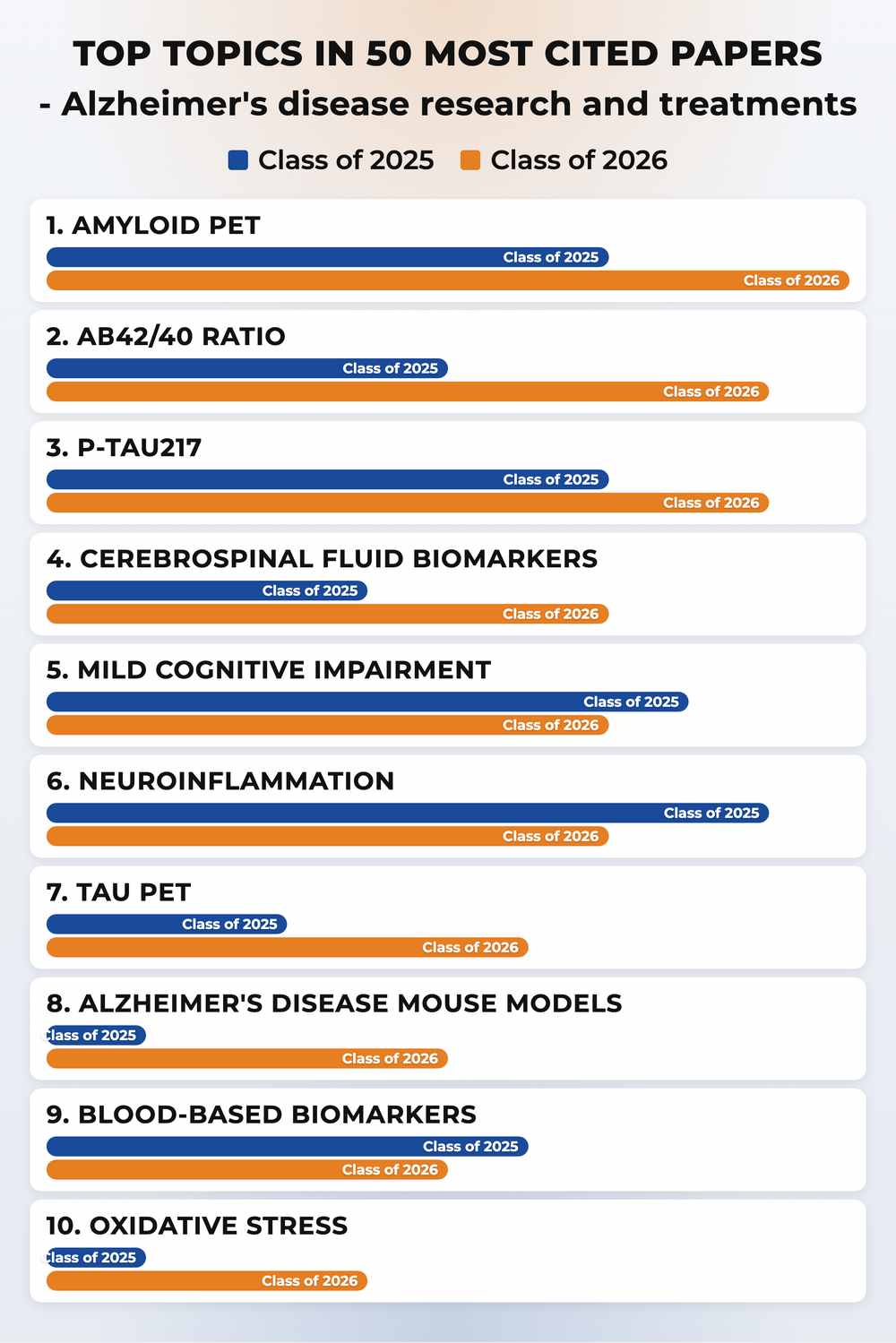
Between the Class of 2025 and the Class of 2026, research priorities in Alzheimer's disease underwent a striking shift from generalized cellular mechanisms to quantitative, clinically actionable diagnostic tools. The most dramatic surging topics were highly specific plasma and imaging markers: Amyloid PET increased its representation from 14% to 20%, while Aβ42/40 ratio expanded from 10% to 18% (an 80% relative growth), and Tau PET doubled from 6% to 12%. Plasma p-tau217 also saw sustained growth (14% to 18%), reflecting rapid widespread clinical adoption of blood-based testing. Furthermore, preclinical validation in mouse models surged fivefold (from 2% to 10%), alongside new focus on oxidative stress (2% to 8%). Conversely, broader diagnostic and pathophysiological descriptors experienced noticeable relative declines. General tau accumulation mentions fell sharply (28% to 12%), neuroinflammation dropped from 18% to 14%, and mild cognitive impairment decreased from 16% to 14%. This transition demonstrates that the field is rapidly progressing beyond broad qualitative labels toward rigorous, standardized biomarker combinations capable of detecting Alzheimer's pathology prior to overt clinical dementia.
Methodology
PRI identifies high-impact research using a transparent, topic-agnostic framework applied consistently across scientific domains. Bibliographic records are drawn from OpenAlex, including publication dates, citation relationships, and document types.
This ranking covers the Class of 2026 cohort: journal articles published in 2024. Reviews and other non-article document types are excluded to ensure comparability.
Research impact is quantified with an 18-month post-publication citation window—the number of citing works published within 18 months of each paper's publication date. This metric captures early impact while controlling for publication age.
An LLM-based relevance classifier then reviews each candidate's title and abstract to confirm substantive alignment with the target domain. Only papers classified as relevant appear in the final ranking.
Zheng Su, Tinsley Li, Thematic Shifts in Early-High-Impact Cancer Genomics and Diagnostics Research: A Bibliometric and Semantic Analysis. bioRxiv 2026.07.04.736459; doi: https://doi.org/10.64898/2026.07.04.736459
Cite this ranking
Pepkio Research Index (PRI). Topics and Trends in Most Cited Alzheimer's disease research and treatments Papers, Class of 2026. https://pri.pepkio.com/top-papers/alzheimer-s-disease-research-and-treatments/2026. Accessed 2026-10-21.

Methodology
Zheng Su, Tinsley Li, Thematic Shifts in Early-High-Impact Cancer Genomics and Diagnostics Research: A Bibliometric and Semantic Analysis. bioRxiv 2026.07.04.736459; doi: https://doi.org/10.64898/2026.07.04.736459
Source data
The full ranking corpus and analysis files are openly available on an external repository. Please cite the dataset below when reusing this data.
View source dataset →Pepkio Research Index (2026). Top papers in Alzheimer's disease research and treatments (Class of 2026) [Data set]. Figshare.