
What topics and trends defined most-cited Epilepsy research and treatment research in the Class of 2026?
Drug-resistant epilepsy, drug-resistant focal epilepsy, and seizure detection anchor the Class of 2026 epilepsy cohort, alongside EEG-based prediction, valproate and cenobamate safety, and long-term monitoring. From Class of 2025 to 2026, focal refractory disease, extended EEG monitoring, and status epilepticus rose sharply while epilepsy surgery and epileptogenic-zone localization receded among top-cited work.
At a glance
- Field
- Epilepsy research and treatment
- Cohort label
- Class of 2026 (2024 publications)
- Papers analyzed
- 7,354
- Papers ranked
- 20
- Top topics in ranked papers
- Drug-resistant epilepsy, seizure detection, drug-resistant focal epilepsy, valproate, long-term EEG monitoring
- Publication window
- Jan 1, 2024 – Dec 31, 2024
- Eligibility
- Research articles; reviews excluded
- Citation window
- 18 months post-publication
- 18m citation range
- 25–66
- Data source
- OpenAlex · Retrieved Jul 2026
- License
- CC BY 4.0
Rankings
20 papers ranked by 18-month citation count
Risk of Major Congenital Malformations and Exposure to Antiseizure Medication Monotherapy
JAMA Neurology202410.1001/jamaneurol.2024.0258
Epileptic seizure prediction via multidimensional transformer and recurrent neural network fusion
Journal of Translational Medicine202410.1186/s12967-024-05678-7
Determination of oxidative stress level and some antioxidant activities in refractory epilepsy patients
Scientific Reports202410.1038/s41598-024-57224-6
Spike ripples localize the epileptogenic zone best: an international intracranial study
Brain202410.1093/brain/awae037
Development and validation of an automatic machine learning model to predict abnormal increase of transaminase in valproic acid-treated epilepsy
Archives of Toxicology202410.1007/s00204-024-03803-5
A scheme combining feature fusion and hybrid deep learning models for epileptic seizure detection and prediction
Scientific Reports202410.1038/s41598-024-67855-4
Residual and bidirectional LSTM for epileptic seizure detection
Frontiers in Computational Neuroscience202410.3389/fncom.2024.1415967
Over‐ and underreporting of seizures: How big is the problem?
Epilepsia202410.1111/epi.17930
Global, regional, and national time trends in the burden of epilepsy, 1990–2019: an age-period-cohort analysis for the global burden of disease 2019 study
Frontiers in Neurology202410.3389/fneur.2024.1418926
Antiseizure medication use during pregnancy and children’s neurodevelopmental outcomes
Nature Communications202410.1038/s41467-024-53813-1
The fasciola cinereum of the hippocampal tail as an interventional target in epilepsy
Nature Medicine202410.1038/s41591-024-02924-9
<scp>SzCORE</scp>: Seizure Community Open‐Source Research Evaluation framework for the validation of <scp>electroencephalography</scp>‐based automated seizure detection algorithms
Epilepsia202410.1111/epi.18113
Risk of Perinatal and Maternal Morbidity and Mortality Among Pregnant Women With Epilepsy
JAMA Neurology202410.1001/jamaneurol.2024.2375
Hippocampal network activity forecasts epileptic seizures
Nature Medicine202410.1038/s41591-024-03149-6
Long-term neuropsychological trajectories in children with epilepsy: does surgery halt decline?
Brain202410.1093/brain/awae121
A population-based analysis of the global burden of epilepsy across all age groups (1990–2021): utilizing the Global Burden of Disease 2021 data
Frontiers in Neurology202410.3389/fneur.2024.1448596
Identification of four biotypes in temporal lobe epilepsy via machine learning on brain images
Nature Communications202410.1038/s41467-024-46629-6
Investigating the effect of polygenic background on epilepsy phenotype in ‘monogenic’ families
EBioMedicine202410.1016/j.ebiom.2024.105404
Ictal Involvement of the Pulvinar and the Anterior Nucleus of the Thalamus in Patients With Refractory Epilepsy
Neurology202410.1212/wnl.0000000000210039
Second‐line immunotherapy in new onset refractory status epilepticus
Epilepsia202410.1111/epi.17933
Topic trends
Dominant research themes and year-over-year shifts in Epilepsy research and treatment
What Topics Define the Class of 2026?
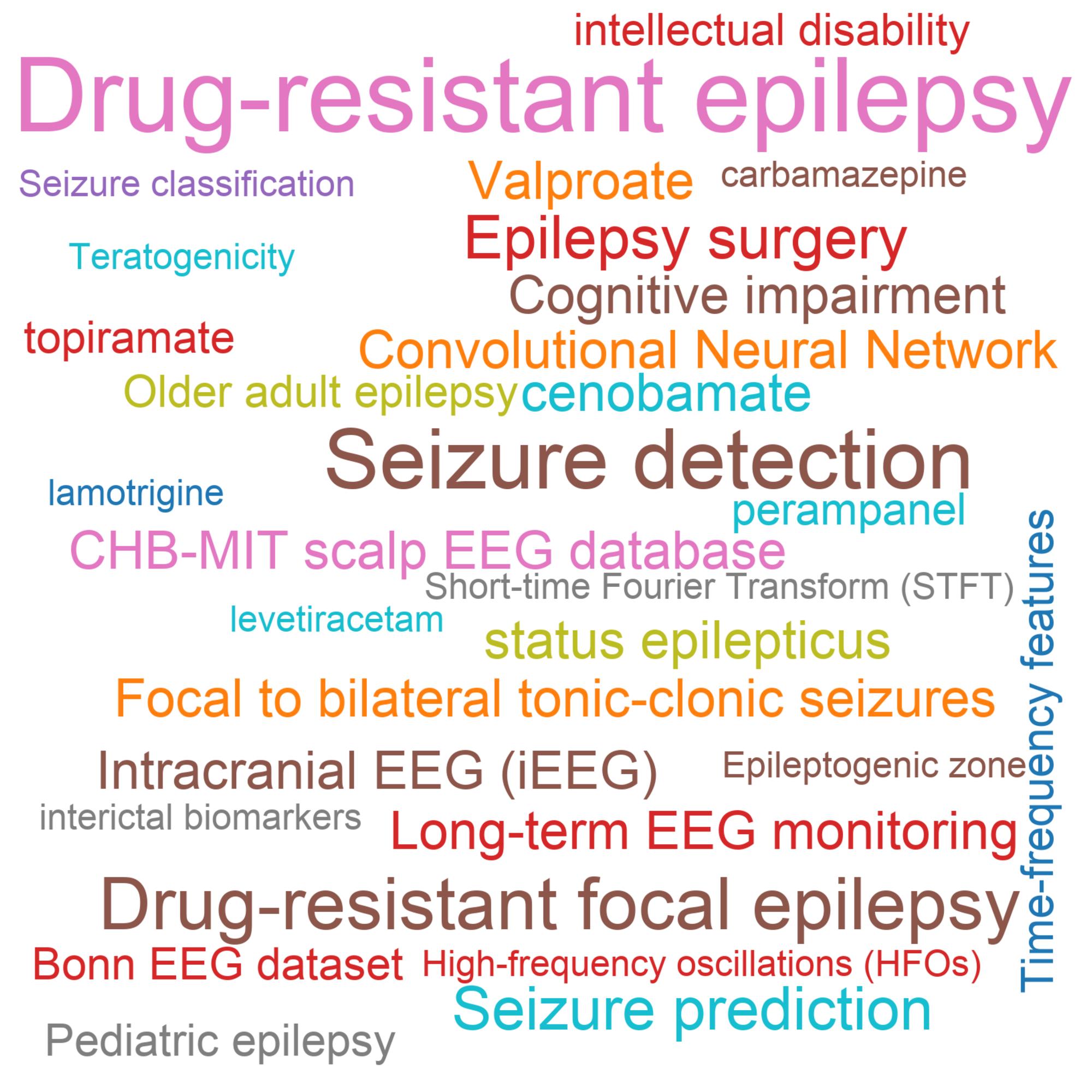
The informative word cloud across the 50 highest 18-month-cited epilepsy research and treatment papers reveals a field organized around refractory disease management, computational seizure analytics, and antiseizure medication decision-making rather than generic epidemiology labels. Drug-resistant epilepsy (DRE) is the most frequently mentioned informative topic, appearing in 13 of 50 papers (normalized frequency 0.26), followed by seizure detection (9 papers, 0.18) and drug-resistant focal epilepsy (7 papers, 0.14). A second tier clusters surgical and predictive themes—epilepsy surgery and seizure prediction each appear in 5 papers (0.10)—alongside valproate, cenobamate, long-term EEG monitoring, status epilepticus, and cognitive impairment (4 papers each, 0.08). Larger type further highlights convolutional neural networks, the CHB-MIT and Bonn EEG datasets, intracranial EEG, focal to bilateral tonic-clonic seizures, and topiramate, signaling that influential 2024 publications increasingly pair clinical refractory-epilepsy cohorts with machine-learning pipelines for detection, classification, and prediction. Antiseizure medication topics—including lamotrigine, carbamazepine, and perampanel—appear alongside pediatric epilepsy and deep brain stimulation, suggesting that high-impact work spans pharmacotherapy safety, neuromodulation targets, and surgical candidacy rather than a single modality.
How Did Topics Shift from the Class of 2025 to the Class of 2026?
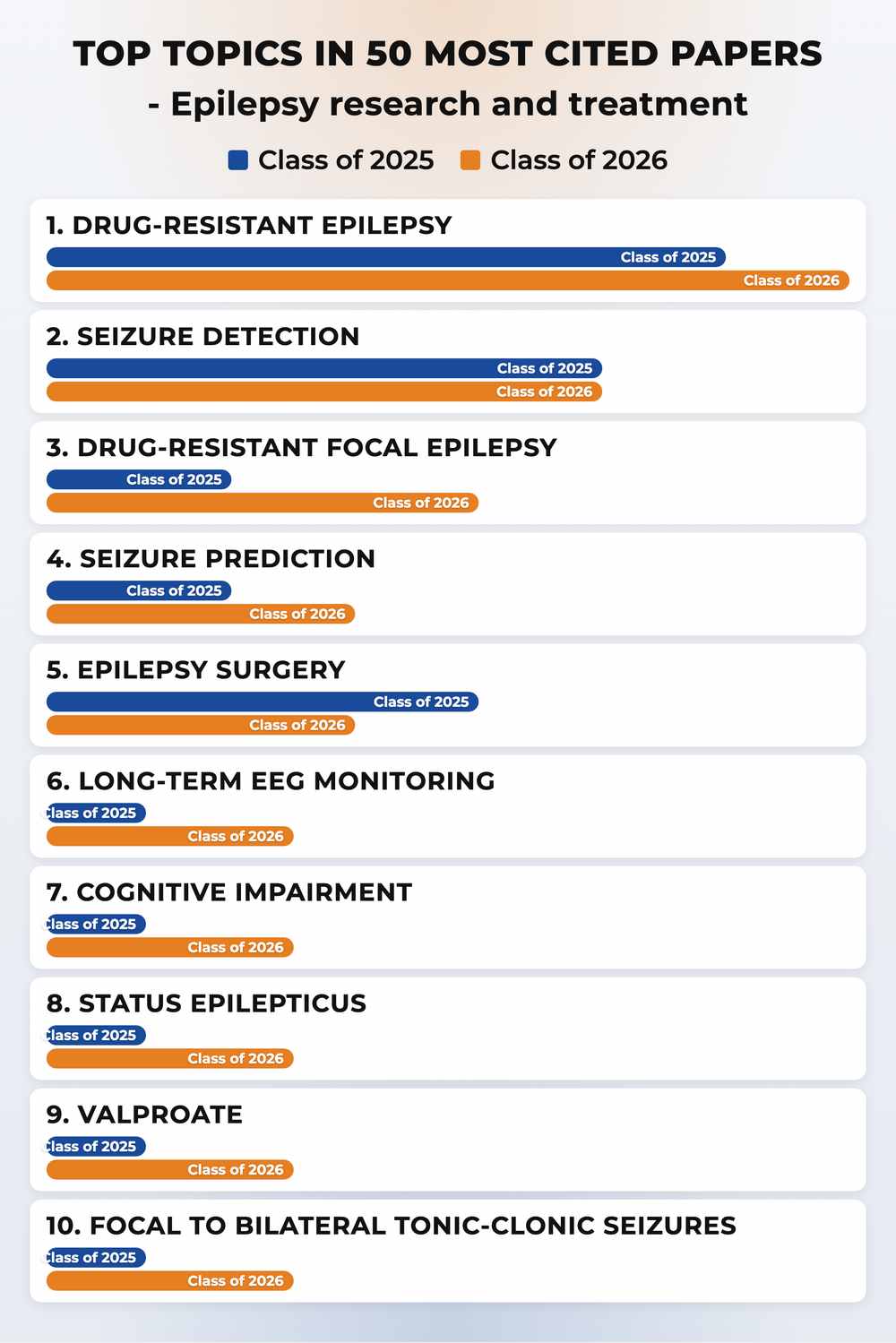
Comparing normalized concept frequencies between the Class of 2025 (2023 publications) and Class of 2026 (2024 publications) cohorts shows a rebalancing of early-high-impact epilepsy research priorities toward focal refractory subtypes, extended monitoring, and medication-specific outcomes. Drug-resistant focal epilepsy exhibited the largest gain among leading themes (+0.08 normalized frequency; 3 versus 7 papers), followed by long-term EEG monitoring (+0.08; 0 versus 4). Cognitive impairment, valproate, status epilepticus, and focal to bilateral tonic-clonic seizures each climbed +0.06 (to 0.08), while seizure prediction rose +0.04 (0.06 to 0.10) and drug-resistant epilepsy itself strengthened modestly (+0.04; 0.22 to 0.26). The topic evolution card underscores that Class of 2026 bars extend furthest for drug-resistant focal epilepsy, long-term EEG monitoring, valproate, cenobamate, and status epilepticus—topics aligned with extended monitoring protocols, ASM safety studies, and refractory focal cohorts—while Class of 2025 led more strongly on broad antiseizure medication framing. Conversely, epilepsy surgery (−0.04; 0.14 to 0.10) and epileptogenic zone localization (−0.04; 0.08 to 0.04) receded among the most-cited concept set, alongside a modest decline in convolutional neural network prominence (−0.02). Together, these shifts suggest that the most-cited 2024 papers emphasize precision monitoring, named antiseizure regimens, focal refractory subtypes, and status epilepticus management over generalized surgery-localization narratives.
Methodology
PRI identifies high-impact research using a transparent, topic-agnostic framework applied consistently across scientific domains. Bibliographic records are drawn from OpenAlex, including publication dates, citation relationships, and document types.
This ranking covers the Class of 2026 cohort: journal articles published in 2024. Reviews and other non-article document types are excluded to ensure comparability.
Research impact is quantified with an 18-month post-publication citation window—the number of citing works published within 18 months of each paper's publication date. This metric captures early impact while controlling for publication age.
An LLM-based relevance classifier then reviews each candidate's title and abstract to confirm substantive alignment with the target domain. Only papers classified as relevant appear in the final ranking.
Zheng Su, Tinsley Li, Thematic Shifts in Early-High-Impact Cancer Genomics and Diagnostics Research: A Bibliometric and Semantic Analysis. bioRxiv 2026.07.04.736459; doi: https://doi.org/10.64898/2026.07.04.736459
Cite this ranking
Pepkio Research Index (PRI). Topics and Trends in Most Cited Epilepsy research and treatment Papers, Class of 2026. https://pri.pepkio.com/top-papers/epilepsy-research-and-treatment/2026. Accessed 2026-10-14.

Methodology
Zheng Su, Tinsley Li, Thematic Shifts in Early-High-Impact Cancer Genomics and Diagnostics Research: A Bibliometric and Semantic Analysis. bioRxiv 2026.07.04.736459; doi: https://doi.org/10.64898/2026.07.04.736459