
What topics and trends defined most-cited Neuroscience and Neuropharmacology Research research in the Class of 2026?
Memory mechanisms and hippocampal circuits dominate the Class of 2026, with major surges in research on memory engrams and astrocyte-neuron interactions. Conversely, broad techniques like optogenetics and calcium imaging saw proportional declines as focus sharpened on specific molecular and cellular pathways.
At a glance
- Field
- Neuroscience and Neuropharmacology Research
- Cohort label
- Class of 2026 (2024 publications)
- Papers analyzed
- 7,381
- Papers ranked
- 20
- Top topics in ranked papers
- Hippocampus, hippocampal neurons, memory engrams, synaptic plasticity
- Publication window
- Jan 1, 2024 – Dec 31, 2024
- Eligibility
- Research articles; reviews excluded
- Citation window
- 18 months post-publication
- 18m citation range
- 57–208
- Data source
- OpenAlex · Retrieved July 2026
- License
- CC BY 4.0
Rankings
20 papers ranked by 18-month citation count
A petavoxel fragment of human cerebral cortex reconstructed at nanoscale resolution
Science202410.1126/science.adk4858
Adenosine signalling to astrocytes coordinates brain metabolism and function
Nature202410.1038/s41586-024-07611-w
Brain clearance is reduced during sleep and anesthesia
Nature Neuroscience202410.1038/s41593-024-01638-y
Abstract representations emerge in human hippocampal neurons during inference
Nature202410.1038/s41586-024-07799-x
Infraslow noradrenergic locus coeruleus activity fluctuations are gatekeepers of the NREM–REM sleep cycle
Nature Neuroscience202410.1038/s41593-024-01822-0
Blood pressure pulsations modulate central neuronal activity via mechanosensitive ion channels
Science202410.1126/science.adk8511
A mouse DRG genetic toolkit reveals morphological and physiological diversity of somatosensory neuron subtypes
Cell202410.1016/j.cell.2024.02.006
Control of working memory by phase–amplitude coupling of human hippocampal neurons
Nature202410.1038/s41586-024-07309-z
Learning-associated astrocyte ensembles regulate memory recall
Nature202410.1038/s41586-024-08170-w
Tonic and burst-like locus coeruleus stimulation distinctly shift network activity across the cortical hierarchy
Nature Neuroscience202410.1038/s41593-024-01755-8
Physical exercise mediates cortical synaptic protein lactylation to improve stress resilience
Cell Metabolism202410.1016/j.cmet.2024.07.018
Multi Targeted Therapy for Alzheimer’s Disease by Guanidinium-Modified Calixarene and Cyclodextrin Co-Assembly Loaded with Insulin
ACS Nano202410.1021/acsnano.4c05693
Dopamine reuptake and inhibitory mechanisms in human dopamine transporter
Nature202410.1038/s41586-024-07796-0
A neurophysiological basis for aperiodic EEG and the background spectral trend
Nature Communications202410.1038/s41467-024-45922-8
Functional specificity of recurrent inhibition in visual cortex
Neuron202410.1016/j.neuron.2023.12.013
Whole-brain spatial organization of hippocampal single-neuron projectomes
Science202410.1126/science.adj9198
Brain region–specific action of ketamine as a rapid antidepressant
Science202410.1126/science.ado7010
Human hippocampal and entorhinal neurons encode the temporal structure of experience
Nature202410.1038/s41586-024-07973-1
Complex activity and short-term plasticity of human cerebral organoids reciprocally connected with axons
Nature Communications202410.1038/s41467-024-46787-7
Selection of experience for memory by hippocampal sharp wave ripples
Science202410.1126/science.adk8261
Topic trends
Dominant research themes and year-over-year shifts in Neuroscience and Neuropharmacology Research
What Topics Define the Class of 2026?
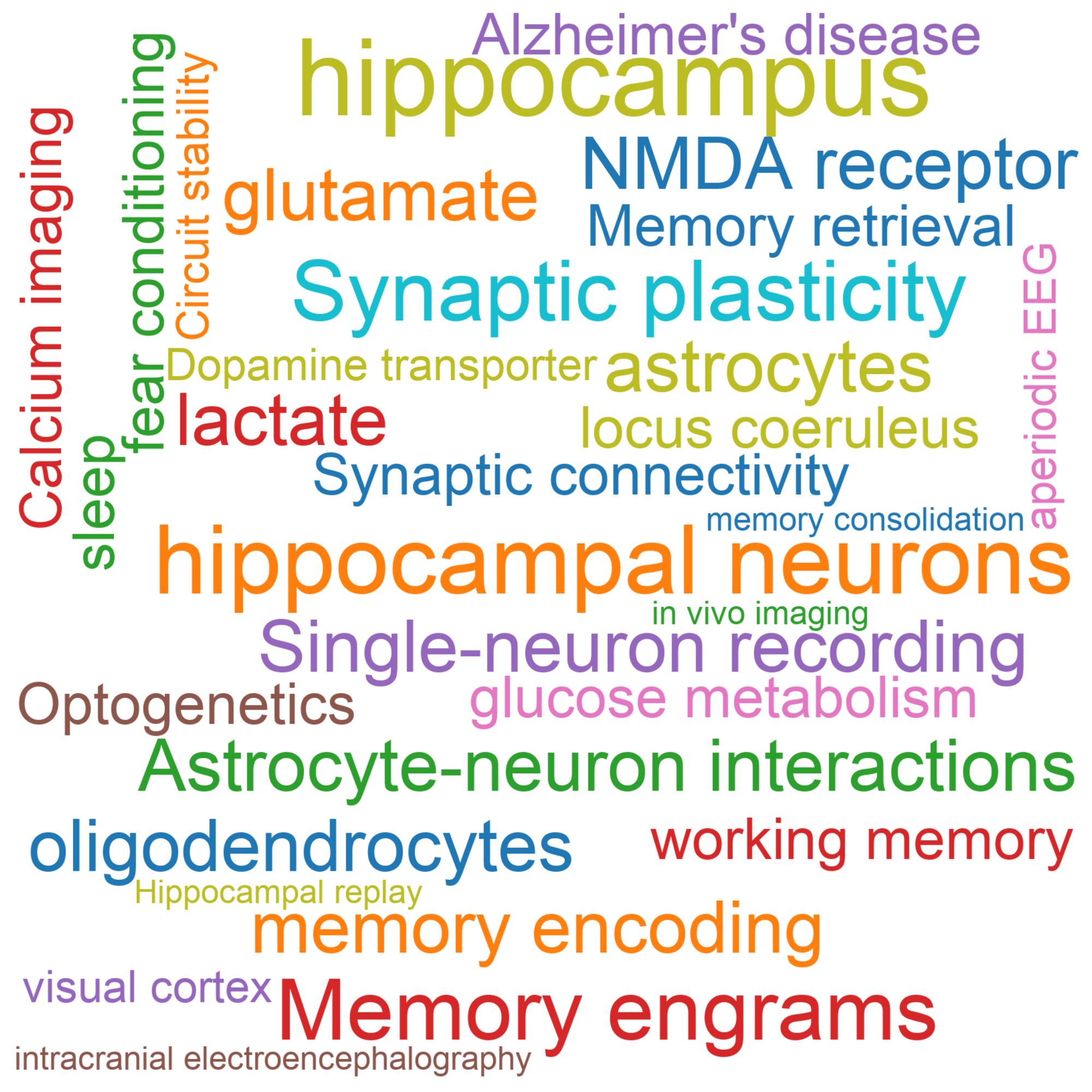
The Class of 2026 in Neuroscience and Neuropharmacology Research is heavily anchored in memory formation and cellular circuitry. The hippocampus emerges as the undisputed focal point, supported by prominent representation of hippocampal neurons and synaptic plasticity. High-resolution cellular mapping is evident through the prevalence of research into memory engrams and single-neuron recordings, indicating a field-wide push to demystify the exact physical traces of memory. Moreover, the metabolic and supporting roles of glial cells are capturing significant attention, as seen in the frequent study of astrocyte-neuron interactions and metabolic substrates like lactate and glutamate. Together, these topics reflect a paradigm where neuropharmacology is increasingly intersecting with ultra-precise cellular engram analysis and neuro-glial metabolic coupling.
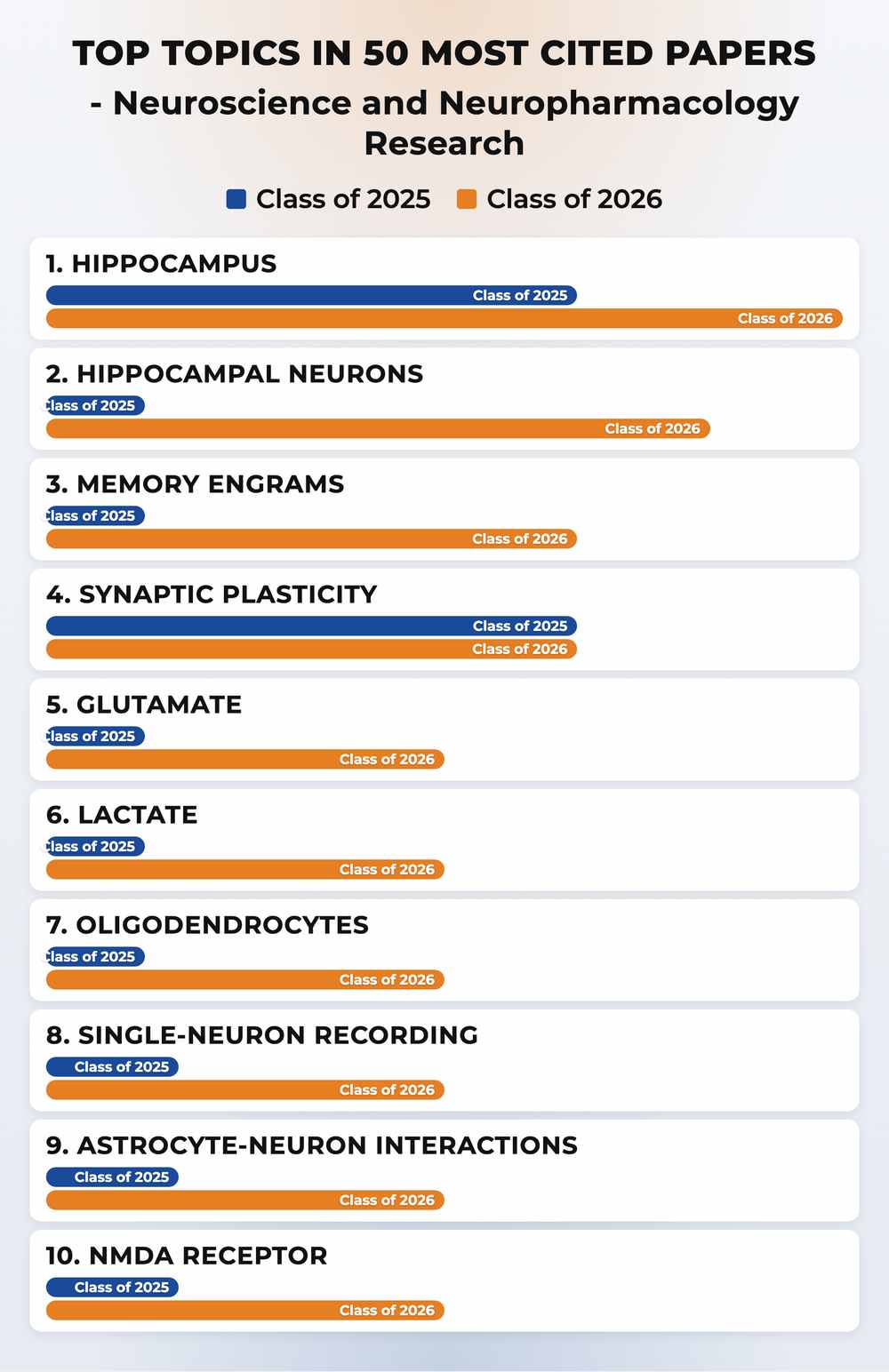
How Did Topics Shift from the Class of 2025 to the Class of 2026?
A comparison between the Class of 2025 and 2026 reveals a distinct transition from broad methodological techniques to highly specific cellular subjects. The most explosive growth was seen in hippocampal neurons and memory engrams, which were absent from the top concepts in the previous year but surged to dominate the current cohort. Similarly, topics related to neurotransmitters and glial cells, such as glutamate, lactate, and oligodendrocytes, experienced massive proportional increases. In contrast, widely used experimental methodologies that previously led the field—such as optogenetics and calcium imaging—experienced notable proportional declines. This pattern suggests that while these tools remain essential, the frontier of high-impact research has moved past methodological development toward the direct application of these tools in uncovering the granular mechanics of memory and astrocyte-neuron interactions.
Methodology
PRI identifies high-impact research using a transparent, topic-agnostic framework applied consistently across scientific domains. Bibliographic records are drawn from OpenAlex, including publication dates, citation relationships, and document types.
This ranking covers the Class of 2026 cohort: journal articles published in 2024. Reviews and other non-article document types are excluded to ensure comparability.
Research impact is quantified with an 18-month post-publication citation window—the number of citing works published within 18 months of each paper's publication date. This metric captures early impact while controlling for publication age.
An LLM-based relevance classifier then reviews each candidate's title and abstract to confirm substantive alignment with the target domain. Only papers classified as relevant appear in the final ranking.
Zheng Su, Tinsley Li, Thematic Shifts in Early-High-Impact Cancer Genomics and Diagnostics Research: A Bibliometric and Semantic Analysis. bioRxiv 2026.07.04.736459; doi: https://doi.org/10.64898/2026.07.04.736459
Cite this ranking
Pepkio Research Index (PRI). Topics and Trends in Most Cited Neuroscience and Neuropharmacology Research Papers, Class of 2026. https://pri.pepkio.com/top-papers/neuroscience-and-neuropharmacology-research/2026. Accessed 2026-10-14.

Methodology
Zheng Su, Tinsley Li, Thematic Shifts in Early-High-Impact Cancer Genomics and Diagnostics Research: A Bibliometric and Semantic Analysis. bioRxiv 2026.07.04.736459; doi: https://doi.org/10.64898/2026.07.04.736459