
What topics and trends defined most-cited Agriculture and Biological Studies research in the Class of 2026?
The Class of 2026 reflects a sharp pivot toward understanding geopolitical disruptions in agriculture, spearheaded by the Russia-Ukraine conflict's impact on global trade. Alongside crisis response, researchers are prioritizing soil resilience—evidenced by rising interest in humic acids—and intensifying focus on the cultivation and biochemistry of Hemerocallis citrina.
At a glance
- Field
- Agriculture and Biological Studies
- Cohort label
- Class of 2026 (2024 publications)
- Papers analyzed
- 5369
- Papers ranked
- 20
- Top topics in ranked papers
- Hemerocallis citrina, Russia-Ukraine conflict, Hilly and mountainous areas, Gut microbiota
- Publication window
- Jan 1, 2024 – Dec 31, 2024
- Eligibility
- Research articles; reviews excluded
- Citation window
- 18 months post-publication
- 18m citation range
- 12–48
- Data source
- OpenAlex · Retrieved June 2026
- License
- CC BY 4.0
Rankings
20 papers ranked by 18-month citation count
Glutathione S-transferase: A versatile and dynamic enzyme
Biochemical and Biophysical Research Communications202410.1016/j.bbrc.2024.150774
Weed management challenges in modern agriculture: The role of environmental factors and fertilization strategies
Crop Protection202410.1016/j.cropro.2024.106903
Ultrasonic-assisted plasma-activated water extraction of polysaccharide from Hemerocallis citrina Baroni: Structural characterization and antioxidant mechanism in vitro
Food Chemistry202410.1016/j.foodchem.2024.142049
Regional irrigation expansion can support climate-resilient crop production in post-invasion Ukraine
Nature Food202410.1038/s43016-024-01017-7
War threatens 18 % of protective plantations in eastern agroforestry region of Ukraine
Forest Ecology and Management202410.1016/j.foreco.2024.122361
Cordyceps polysaccharide improves polycystic ovary syndrome by inhibiting gut-derived LPS/TLR4 pathway to attenuates insulin resistance
International Journal of Biological Macromolecules202410.1016/j.ijbiomac.2024.135844
Analysis of Formal Concepts for Verification of Pests and Diseases of Crops Using Machine Learning Methods
IEEE Access202410.1109/access.2024.3361046
Screening and Evaluation of Salt-Tolerant Wheat Germplasm Based on the Main Morphological Indices at the Germination and Seedling Stages
Plants202410.3390/plants13223201
Humic Substances from Waste-Based Fertilizers for Improved Soil Fertility
Agronomy202410.3390/agronomy14112657
Responsive mechanism of Hemerocallis citrina Baroni to complex saline-alkali stress revealed by photosynthetic characteristics and antioxidant regulation
Plant Cell Reports202410.1007/s00299-024-03261-4
Traditional uses, phytochemical constituents, pharmacological properties, and quality control of Pseudostellaria heterophylla (Miq.) Pax
Journal of Ethnopharmacology202410.1016/j.jep.2024.118871
Effect of Dietary Concentrate-to-Forage Ratios During the Cold Season on Slaughter Performance, Meat Quality, Rumen Fermentation and Gut Microbiota of Tibetan Sheep
Animals202410.3390/ani14223305
Impact of dietary Bacillus toyonensis M44 as an antibiotic alternative on growth, blood biochemical properties, immunity, gut microbiota, and meat quality of IR broilers
Pakistan Veterinary Journal202410.29261/pakvetj/2024.215
Ecological Assessment of Heavy Metal Content in Ukrainian Soils
Journal of Ecological Engineering202410.12911/22998993/192669
Codon usage characterization and phylogenetic analysis of the mitochondrial genome in Hemerocallis citrina
BMC Genomic Data202410.1186/s12863-024-01191-4
The pan-plastome of Hemerocallis citrina reveals new insights into the genetic diversity and cultivation history of an economically important food plant
BMC Plant Biology202410.1186/s12870-023-04668-z
Development of an autonomous drone spraying control system based on the coefficient of variation of spray distribution
Computers and Electronics in Agriculture202410.1016/j.compag.2024.109529
Estimation of sunflower planted areas in Ukraine during full-scale Russian invasion: Insights from Sentinel-1 SAR data
Science of Remote Sensing202410.1016/j.srs.2024.100139
Impact of Cd and Pb on the photosynthetic and antioxidant systems of Hemerocallis citrina Baroni as revealed by physiological and transcriptomic analyses
Plant Cell Reports202410.1007/s00299-024-03312-w
Neuroprotective effects of total phenolics from Hemerocallis citrina Baroni leaves through the PI3K/AKT pathway
Frontiers in Pharmacology202410.3389/fphar.2024.1370619
Topic trends
Dominant research themes and year-over-year shifts in Agriculture and Biological Studies
What Topics Define the Class of 2026?
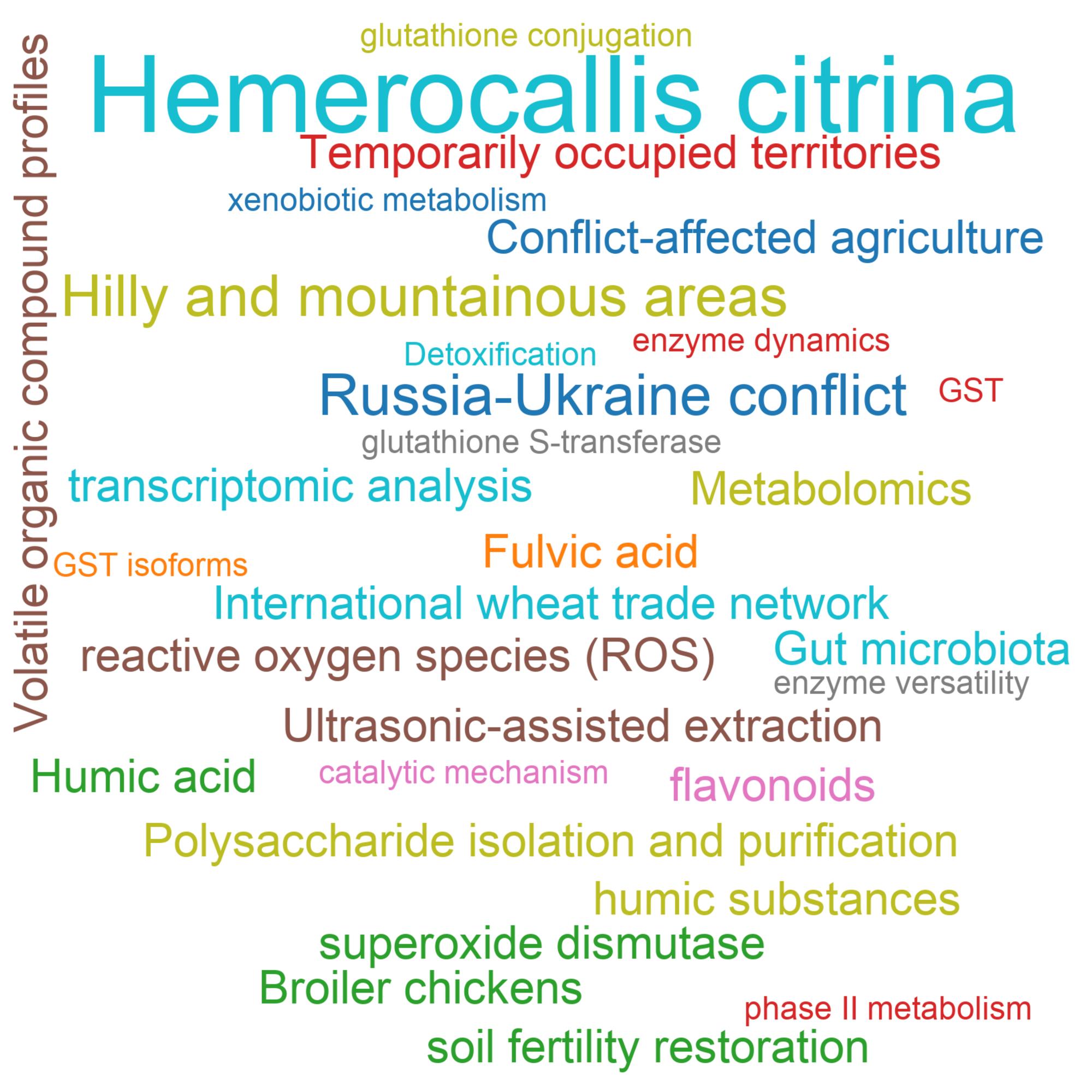
The research landscape is strongly defined by studies on Hemerocallis citrina, which is the most frequently mentioned concept, highlighting a strong interest in this specific crop. Beyond this, a prominent cluster focuses on the geopolitical impacts on agriculture, driven by terms like "Russia-Ukraine conflict", "Conflict-affected agriculture", "Temporarily occupied territories", and the "International wheat trade network". This indicates an acute awareness of global disruptions to food supply chains and agricultural infrastructure. A secondary cluster emphasizes agricultural sustainability and soil health, featuring "Humic acid", "Fulvic acid", "soil fertility restoration", and agricultural adaptation to "Hilly and mountainous areas". Lastly, there is sustained interest in plant biochemistry and its intersection with health, underscored by concepts like "Metabolomics", "Gut microbiota", "Ultrasonic-assisted extraction", and "Polysaccharide isolation and purification".
How Did Topics Shift from the Class of 2025 to the Class of 2026?
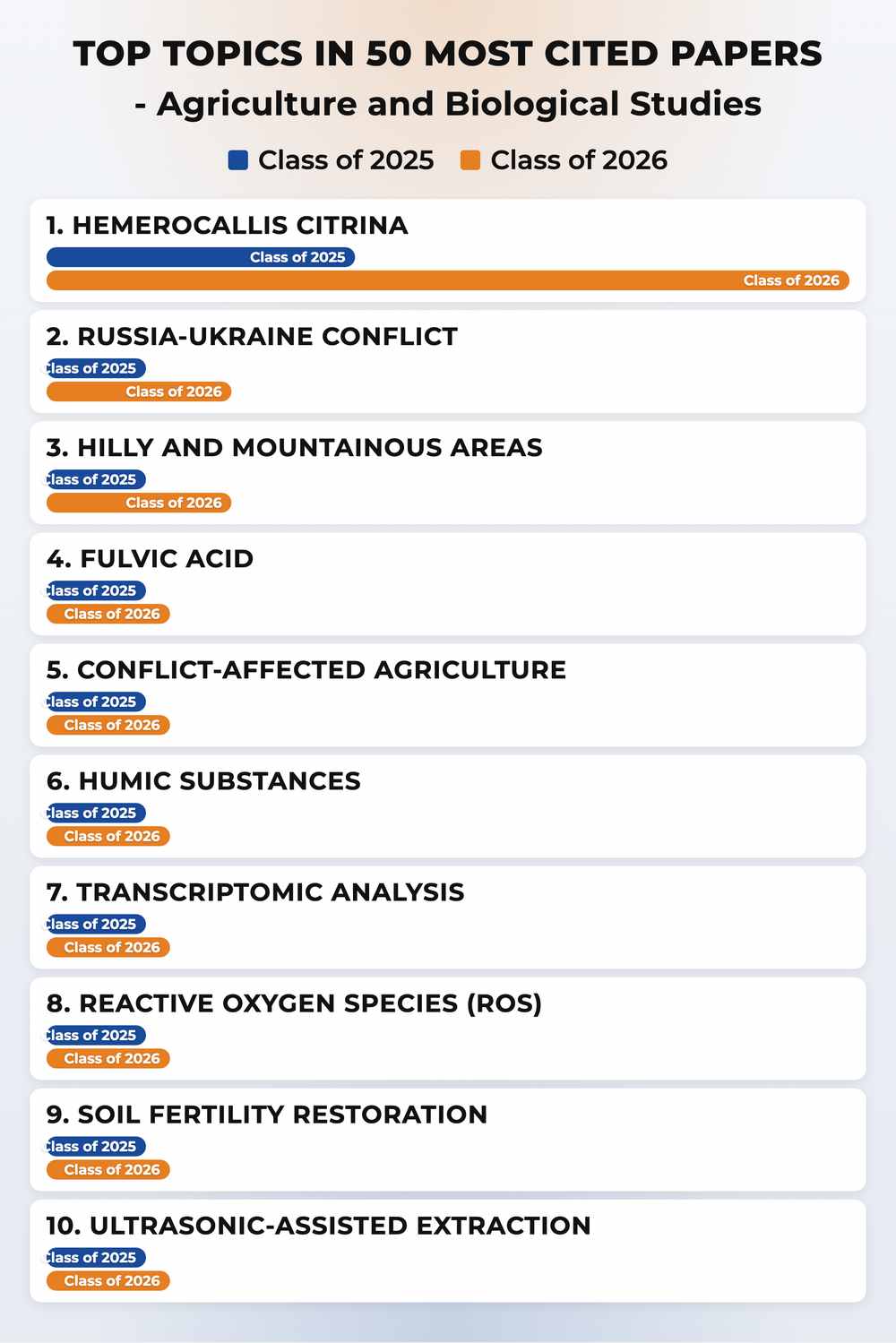
The transition to the Class of 2026 is marked by an extraordinary surge in research addressing geopolitical disruptions. Concepts such as "Russia-Ukraine conflict", "Conflict-affected agriculture", and "Temporarily occupied territories" saw the most dramatic relative increases, jumping from virtually zero presence to prominent focal points. This reflects a rapid realignment of agricultural research toward crisis management and global trade impacts. Simultaneously, the specific study of Hemerocallis citrina experienced the largest absolute growth, significantly expanding its footprint. There was also a notable new emergence of soil amendment topics, with "Humic acid", "Fulvic acid", and "humic substances" gaining traction alongside research tailored to "Hilly and mountainous areas". This combination points toward an increasing emphasis on resilient and adaptive agricultural practices designed to navigate both environmental constraints and ongoing conflict.
Methodology
PRI identifies high-impact research using a transparent, topic-agnostic framework applied consistently across scientific domains. Bibliographic records are drawn from OpenAlex, including publication dates, citation relationships, and document types.
This ranking covers the Class of 2026 cohort: journal articles published in 2024. Reviews and other non-article document types are excluded to ensure comparability.
Research impact is quantified with an 18-month post-publication citation window—the number of citing works published within 18 months of each paper's publication date. This metric captures early impact while controlling for publication age.
An LLM-based relevance classifier then reviews each candidate's title and abstract to confirm substantive alignment with the target domain. Only papers classified as relevant appear in the final ranking.
Zheng Su, Tinsley Li, Thematic Shifts in Early-High-Impact Cancer Genomics and Diagnostics Research: A Bibliometric and Semantic Analysis. bioRxiv 2026.07.04.736459; doi: https://doi.org/10.64898/2026.07.04.736459
Cite this ranking
Pepkio Research Index (PRI). Topics and Trends in Most Cited Agriculture and Biological Studies Papers, Class of 2026. https://pri.pepkio.com/top-papers/agriculture-and-biological-studies/2026. Accessed 2026-10-24.

Methodology
Zheng Su, Tinsley Li, Thematic Shifts in Early-High-Impact Cancer Genomics and Diagnostics Research: A Bibliometric and Semantic Analysis. bioRxiv 2026.07.04.736459; doi: https://doi.org/10.64898/2026.07.04.736459