
What topics and trends defined most-cited Neurobiology and Insect Physiology Research research in the Class of 2026?
The Class of 2026 in insect neurobiology is anchored by whole-brain connectomics and synaptic connectivity, with Drosophila melanogaster remaining the primary model organism. Whole-brain connectomics and descending motor neurons surged sharply, while single-cell receptor recording and classical neurotransmitter signaling topics experienced relative declines.
At a glance
- Field
- Neurobiology and Insect Physiology Research
- Cohort label
- Class of 2026 (2024 publications)
- Papers analyzed
- 3,912
- Papers ranked
- 20
- Top topics in ranked papers
- Connectome, synaptic connectivity, courtship behavior, descending neurons, chemosensory processing
- Publication window
- Jan 1, 2024 – Dec 31, 2024
- Eligibility
- Research articles; reviews excluded
- Citation window
- 18 months post-publication
- 18m citation range
- 38–400
- Data source
- OpenAlex · Retrieved Jul 2026
- License
- CC BY 4.0
Rankings
20 papers ranked by 18-month citation count
Neuronal wiring diagram of an adult brain
Nature202410.1038/s41586-024-07558-y
Whole-brain annotation and multi-connectome cell typing of Drosophila
Nature202410.1038/s41586-024-07686-5
Keypoint-MoSeq: parsing behavior by linking point tracking to pose dynamics
Nature Methods202410.1038/s41592-024-02318-2
Neurotransmitter classification from electron microscopy images at synaptic sites in Drosophila melanogaster
Cell202410.1016/j.cell.2024.03.016
Network statistics of the whole-brain connectome of Drosophila
Nature202410.1038/s41586-024-07968-y
Structural basis for odorant recognition of the insect odorant receptor OR-Orco heterocomplex
Science202410.1126/science.adn6881
Structural basis of odor sensing by insect heteromeric odorant receptors
Science202410.1126/science.adn6384
Connectomic reconstruction of a female Drosophila ventral nerve cord
Nature202410.1038/s41586-024-07389-x
Connectome-constrained networks predict neural activity across the fly visual system
Nature202410.1038/s41586-024-07939-3
Synaptic connectome of the Drosophila circadian clock
Nature Communications202410.1038/s41467-024-54694-0
A Drosophila computational brain model reveals sensorimotor processing
Nature202410.1038/s41586-024-07763-9
Neuronal parts list and wiring diagram for a visual system
Nature202410.1038/s41586-024-07981-1
Converting an allocentric goal into an egocentric steering signal
Nature202410.1038/s41586-023-07006-3
Why flying insects gather at artificial light
Nature Communications202410.1038/s41467-024-44785-3
Synaptic architecture of leg and wing premotor control networks in Drosophila
Nature202410.1038/s41586-024-07600-z
Structural basis for sugar perception by <i>Drosophila</i> gustatory receptors
Science202410.1126/science.adj2609
miR-276 and miR-182013-5p modulate insect metamorphosis and reproduction via dually regulating juvenile hormone acid methyltransferase
Communications Biology202410.1038/s42003-024-07285-0
Thermal infrared directs host-seeking behaviour in Aedes aegypti mosquitoes
Nature202410.1038/s41586-024-07848-5
Engineered odorant receptors illuminate the basis of odour discrimination
Nature202410.1038/s41586-024-08126-0
Common principles for odour coding across vertebrates and invertebrates
Nature reviews. Neuroscience202410.1038/s41583-024-00822-0
Topic trends
Dominant research themes and year-over-year shifts in Neurobiology and Insect Physiology Research
What Topics Define the Class of 2026?
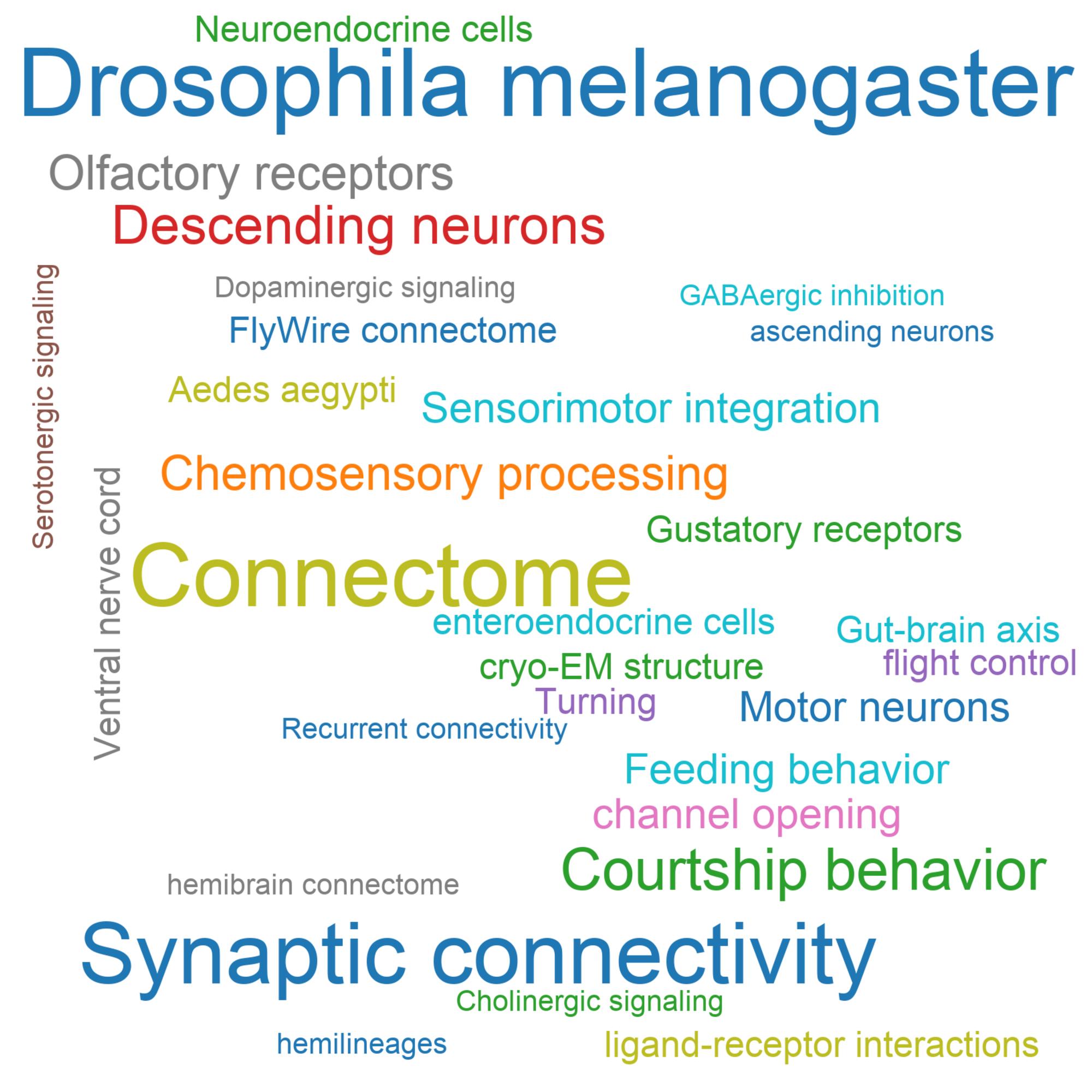
The Class of 2026 in insect neurobiology and physiology is dominated by whole-brain structural and functional mapping. Drosophila melanogaster remains the foundational model organism for genetic and optical manipulation, featured in 36% of top-ranked publications in this field. The primary intellectual engine driving recent progress is circuit-level connectomics, highlighted by the prominent representation of Connectome (32% of papers) and Synaptic connectivity (30%). Neural circuit analyses increasingly target complex innate behaviors, led by Courtship behavior (14%), Descending neurons (12%), and Sensorimotor integration (8%). Secondary research clusters focus on sensory processing and neurophysiology, including Chemosensory processing (10%), Olfactory receptors (10%), Feeding behavior (8%), Motor neurons (8%), and biophysical channel opening dynamics (8%). Emerging work integrates FlyWire connectomic datasets with computational neural network modeling, gut-brain axis communication, and cryo-EM structures of membrane receptors. Together, these thematic topics demonstrate that modern insect physiology research has transitioned from isolated single-neuron recordings into an era of brain-wide synaptic connectomics, descending motor control architecture, and high-resolution structural neurobiology.
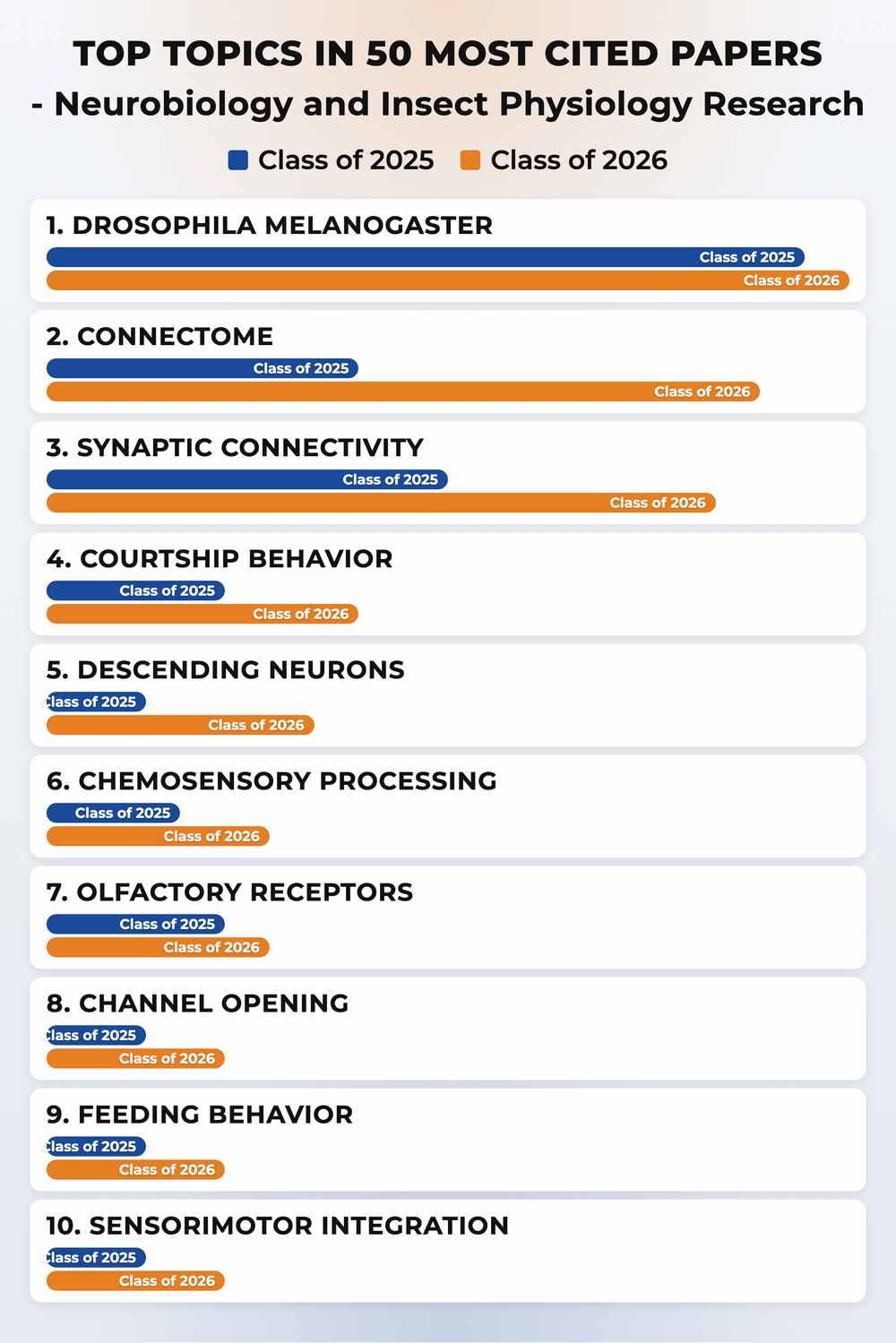
How Did Topics Shift from the Class of 2025 to the Class of 2026?
Comparing the Class of 2025 and Class of 2026 reveals a dramatic reallocation of research focus toward circuit-scale reconstruction and motor command control. Connectome emerged as the top rising concept, expanding from 14% of papers in 2023 (7 papers) to 32% in 2024 (16 papers, representing a +18 percentage point gain and 2.29-fold increase). Synaptic connectivity grew from 18% to 30% (+12 percentage points), while Descending neurons surged sixfold from 2% to 12% (1 to 6 papers). Breakthrough topics appearing for the first time in 2024 include ion channel opening (8%), FlyWire connectome resources (6%), cryo-EM structure determination (6%), Gustatory receptors (6%), and Neuroendocrine cells (6%). In contrast, single-cell functional profiling and traditional neurotransmitter signaling saw relative declines: Olfactory receptor neurons decreased from 10% to 4%, while Cholinergic signaling and Dopaminergic signaling each dropped from 8% to 4%. Motor neurons remained stable at 8%. These shifts reflect a field-wide transition toward structural circuit mapping and brain-wide descending motor control.
Methodology
PRI identifies high-impact research using a transparent, topic-agnostic framework applied consistently across scientific domains. Bibliographic records are drawn from OpenAlex, including publication dates, citation relationships, and document types.
This ranking covers the Class of 2026 cohort: journal articles published in 2024. Reviews and other non-article document types are excluded to ensure comparability.
Research impact is quantified with an 18-month post-publication citation window—the number of citing works published within 18 months of each paper's publication date. This metric captures early impact while controlling for publication age.
An LLM-based relevance classifier then reviews each candidate's title and abstract to confirm substantive alignment with the target domain. Only papers classified as relevant appear in the final ranking.
Zheng Su, Tinsley Li, Thematic Shifts in Early-High-Impact Cancer Genomics and Diagnostics Research: A Bibliometric and Semantic Analysis. bioRxiv 2026.07.04.736459; doi: https://doi.org/10.64898/2026.07.04.736459
Cite this ranking
Pepkio Research Index (PRI). Topics and Trends in Most Cited Neurobiology and Insect Physiology Research Papers, Class of 2026. https://pri.pepkio.com/top-papers/neurobiology-and-insect-physiology-research/2026. Accessed 2026-10-16.

Methodology
Zheng Su, Tinsley Li, Thematic Shifts in Early-High-Impact Cancer Genomics and Diagnostics Research: A Bibliometric and Semantic Analysis. bioRxiv 2026.07.04.736459; doi: https://doi.org/10.64898/2026.07.04.736459