
What topics and trends defined most-cited Air Quality and Health Impacts research in the Class of 2026?
The Class of 2026 in Air Quality and Health Impacts highlights a shift toward high-precision exposure modeling and specific pollutant analysis. While PM2.5 remains a core focus, topics like PM10, nitrogen dioxide, and exposure-response functions saw significant growth, underscoring an increasing emphasis on refined methodologies and vulnerable populations.
At a glance
- Field
- Air Quality and Health Impacts
- Cohort label
- Class of 2026 (2024 publications)
- Papers analyzed
- 12,654
- Papers ranked
- 20
- Top topics in ranked papers
- PM2.5, Exposure-response function, Nitrogen dioxide
- Publication window
- Jan 1, 2024 – Dec 31, 2024
- Eligibility
- Research articles; reviews excluded
- Citation window
- 18 months post-publication
- 18m citation range
- 59–239
- Data source
- OpenAlex · Retrieved September 2026
- License
- CC BY 4.0
Rankings
20 papers ranked by 18-month citation count
Efficacy of China’s clean air actions to tackle PM2.5 pollution between 2013 and 2020
Nature Geoscience202410.1038/s41561-024-01540-z
Impact of environmental pollution from human activities on water, air quality and climate change
Ecological Frontiers202410.1016/j.ecofro.2024.02.014
Comparative Analysis of Multiple Deep Learning Models for Forecasting Monthly Ambient PM2.5 Concentrations: A Case Study in Dezhou City, China
Atmosphere202410.3390/atmos15121432
Real-time IoT-powered AI system for monitoring and forecasting of air pollution in industrial environment
Ecotoxicology and Environmental Safety202410.1016/j.ecoenv.2024.116856
Temperature-dependent emissions dominate aerosol and ozone formation in Los Angeles
Science202410.1126/science.adg8204
Nonlinear and threshold effects of the built environment, road vehicles and air pollution on urban vitality
Landscape and Urban Planning202410.1016/j.landurbplan.2024.105204
How does artificial intelligence affect pollutant emissions by improving energy efficiency and developing green technology
Energy Economics202410.1016/j.eneco.2024.107355
Reassessing the role of urban green space in air pollution control
Proceedings of the National Academy of Sciences202410.1073/pnas.2306200121
Ozone trends and their sensitivity in global megacities under the warming climate
Nature Communications202410.1038/s41467-024-54490-w
Estimates of global mortality burden associated with short-term exposure to fine particulate matter (PM2·5)
The Lancet Planetary Health202410.1016/s2542-5196(24)00003-2
Two-decade surface ozone (O3) pollution in China: Enhanced fine-scale estimations and environmental health implications
Remote Sensing of Environment202410.1016/j.rse.2024.114459
Global, regional, and national burden of cancers attributable to particulate matter pollution from 1990 to 2019 and projection to 2050: Worsening or improving?
Journal of Hazardous Materials202410.1016/j.jhazmat.2024.135319
Temperature-related mortality burden and projected change in 1368 European regions: a modelling study
The Lancet Public Health202410.1016/s2468-2667(24)00179-8
Global variability in atmospheric new particle formation mechanisms
Nature202410.1038/s41586-024-07547-1
Coupling Remote Sensing Insights With Vegetation Dynamics and to Analyze NO<sub>2</sub> Concentrations: A Google Earth Engine-Driven Investigation
IEEE Journal of Selected Topics in Applied Earth Observations and Remote Sensing202410.1109/jstars.2024.3397496
Anthropogenic forcing has increased the risk of longer-traveling and slower-moving large contiguous heatwaves
Science Advances202410.1126/sciadv.adl1598
Rising cause-specific mortality risk and burden of compound heatwaves amid climate change
Nature Climate Change202410.1038/s41558-024-02137-5
Global, regional, and national mortality burden attributable to air pollution from landscape fires: a health impact assessment study
The Lancet202410.1016/s0140-6736(24)02251-7
Optimized machine learning model for air quality index prediction in major cities in India
Scientific Reports202410.1038/s41598-024-54807-1
Combined short-term and long-term emission controls improve air quality sustainably in China
Nature Communications202410.1038/s41467-024-49539-9
Topic trends
Dominant research themes and year-over-year shifts in Air Quality and Health Impacts
What Topics Define the Class of 2026?
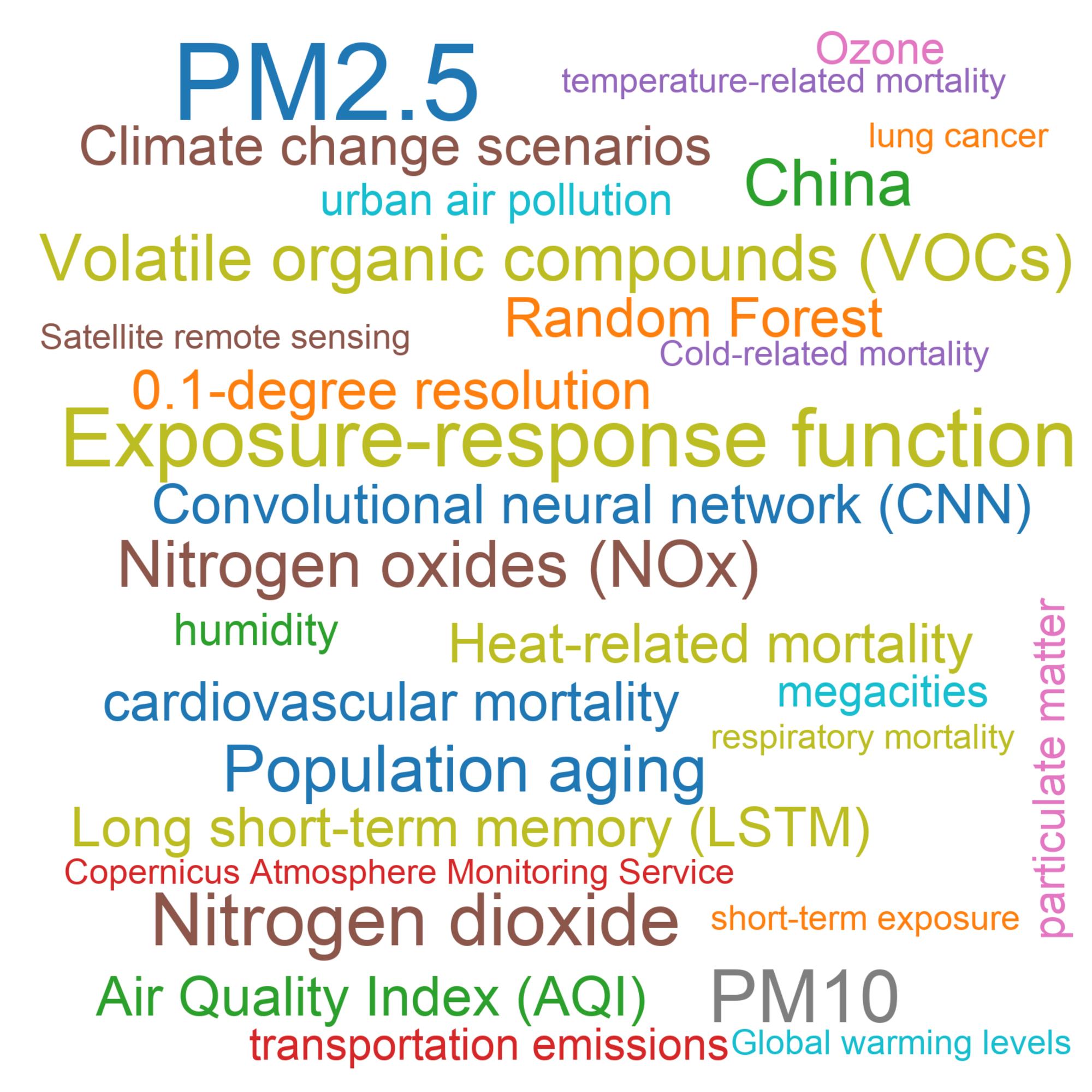
The Class of 2026 in air quality and health impacts is overwhelmingly defined by research into specific pollutants and analytical methodologies. PM2.5 remains a central focus, being the most prominent canonical concept, reflecting its critical role in health impact assessments. Alongside particulate matter, Nitrogen dioxide and Nitrogen oxides (NOx) are leading focal points. Methodologically, there is a strong emphasis on Exposure-response functions to quantify health risks, and the use of high-resolution data, such as 0.1-degree resolution, to improve the accuracy of ambient air pollution measurements. Demographically, Population aging is a significant area of concern, indicating a growing focus on how air quality disproportionately affects vulnerable older populations. Together, these themes underscore a field moving towards more precise exposure modeling and targeted health assessments.
How Did Topics Shift from the Class of 2025 to the Class of 2026?
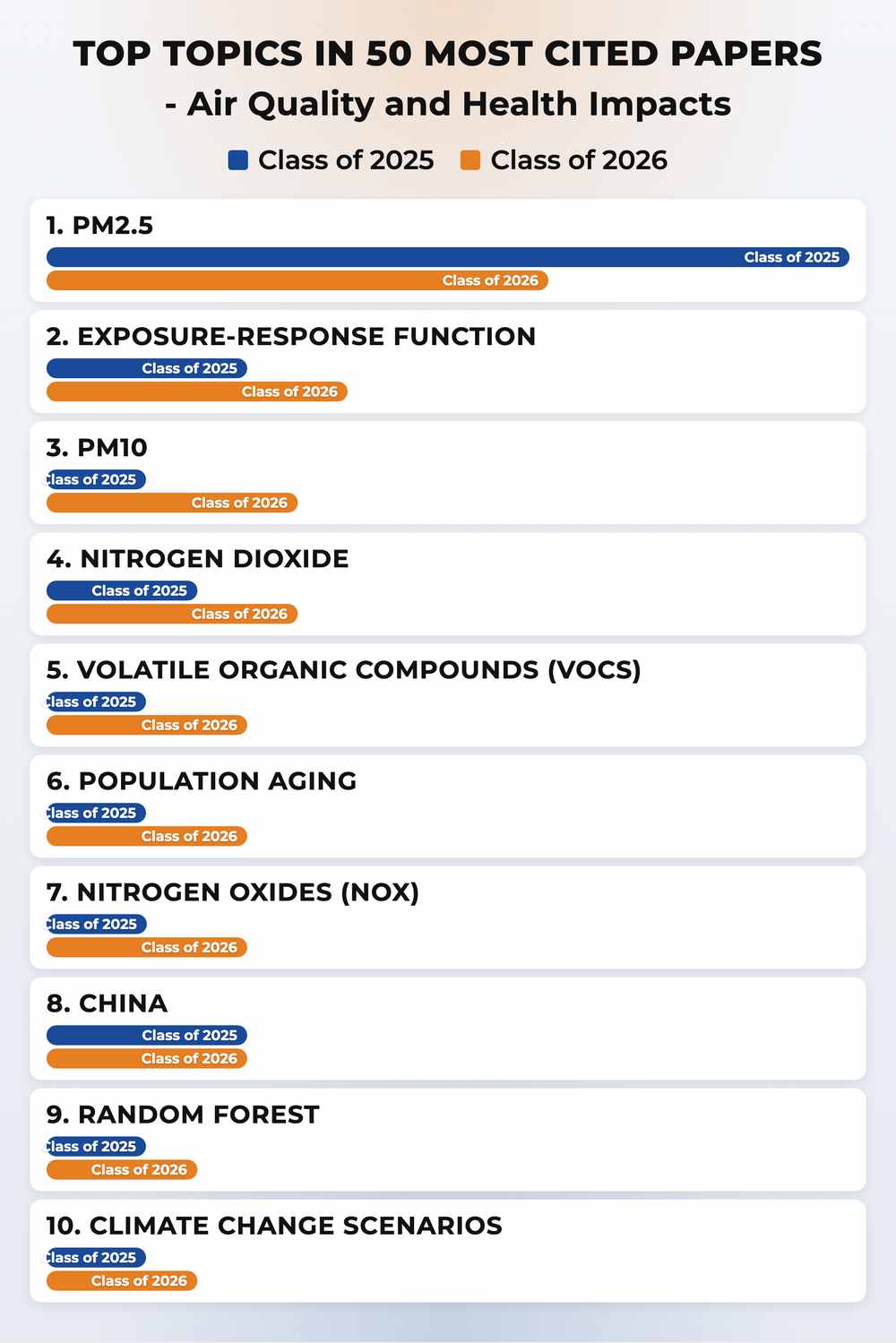
A comparative analysis between the Class of 2025 and 2026 reveals significant shifts in research priorities. Most notably, there is a substantial surge in studies focusing on specific pollutants like PM10, which saw a drastic increase in normalized frequency, alongside steady growth in Nitrogen dioxide and Nitrogen oxides (NOx). Analytical approaches are also evolving, with Exposure-response functions and 0.1-degree resolution methodologies experiencing notable upward trends, indicating a shift towards higher precision in environmental epidemiology. Similarly, Population aging and Volatile organic compounds (VOCs) are gaining momentum. Conversely, research explicitly centering on general concepts like PM2.5 saw a slight decrease in normalized frequency, possibly suggesting that the field is moving beyond broad PM2.5 studies into more nuanced or localized investigations.
Methodology
PRI identifies high-impact research using a transparent, topic-agnostic framework applied consistently across scientific domains. Bibliographic records are drawn from OpenAlex, including publication dates, citation relationships, and document types.
This ranking covers the Class of 2026 cohort: journal articles published in 2024. Reviews and other non-article document types are excluded to ensure comparability.
Research impact is quantified with an 18-month post-publication citation window—the number of citing works published within 18 months of each paper's publication date. This metric captures early impact while controlling for publication age.
An LLM-based relevance classifier then reviews each candidate's title and abstract to confirm substantive alignment with the target domain. Only papers classified as relevant appear in the final ranking.
Zheng Su, Tinsley Li, Thematic Shifts in Early-High-Impact Cancer Genomics and Diagnostics Research: A Bibliometric and Semantic Analysis. bioRxiv 2026.07.04.736459; doi: https://doi.org/10.64898/2026.07.04.736459
Cite this ranking
Pepkio Research Index (PRI). Topics and Trends in Most Cited Air Quality and Health Impacts Papers, Class of 2026. https://pri.pepkio.com/top-papers/air-quality-and-health-impacts/2026. Accessed 2026-10-24.

Methodology
Zheng Su, Tinsley Li, Thematic Shifts in Early-High-Impact Cancer Genomics and Diagnostics Research: A Bibliometric and Semantic Analysis. bioRxiv 2026.07.04.736459; doi: https://doi.org/10.64898/2026.07.04.736459